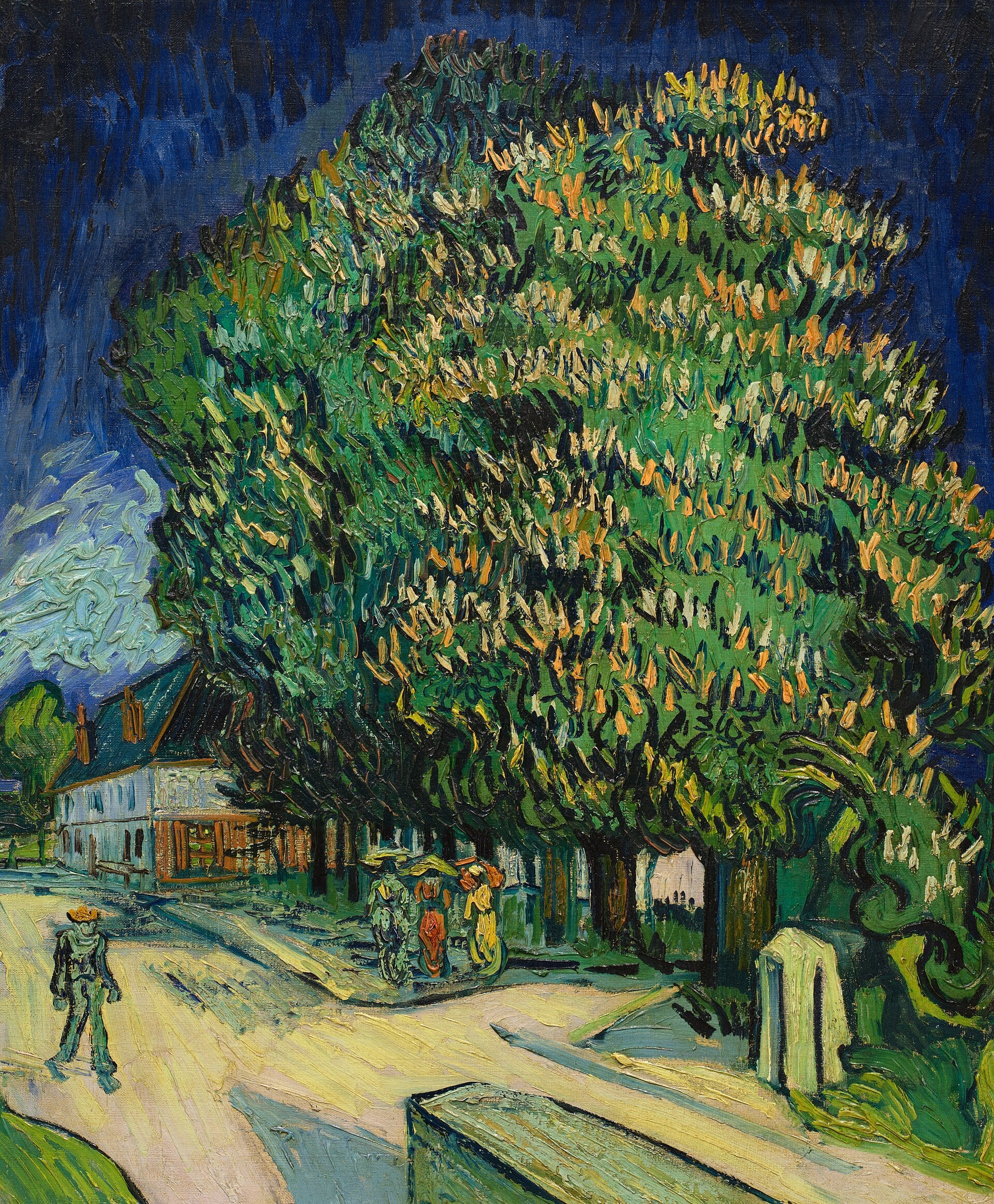
Vincent van Gogh’s “Châtaigniers en Fleurs” was sold at Sotheby’s auction last week for a record $190.4 million (including fees), but the sale almost didn’t happen. That’s because the heirs of the painting’s former owner asked the auction house to withdraw it because of its Nazi history.
Lend Me Your Ear, and I’ll Tell You About This Van Gogh Painting
Van Gogh painted “Châtaigniers en Fleurs” (Blossoming Chestnut Trees) in Auvers-sur-Oise, north of Paris, in 1890. He’d just arrived in the town after his release from a psychiatric hospital in the south of France.
The painting depicts a stand of tall chestnut trees covered in blossoms, just across the road. People walk down the road or stand in the trees' shade, and Van Gogh’s characteristic brushstrokes make everything—the movement of the people, the heat of the day—appear alive.
Two months after painting Blossoming Chestnut Trees, on July 29, 1890, Van Gogh died by suicide in the same town. He was 37.
Heirs Say Blossoming Chestnut Trees Was Sold Under Duress
A prominent German publisher named Samuel Fischer purchased Blossoming Chestnut Trees. He bought it from a Paris gallery in 1909, and it became part of the Fischer family collection. After Samuel’s death in 1934, his son-in-law took over the publishing house. But he faced troubled times. Many of the Jewish writers published by the publishing company had their works banned when the Nazis tightened their grip on Germany.
The family eventually left Germany. The painting was placed with the Paul Cassirer gallery in Amsterdam in 1932 or 1933 and was sold to Paris collectors Henriette and Marcel Kapferer in 1936.
The painting changed hands several times before entering the Blaquier-Arrieta collection — one of the most significant private collections of Impressionist and Post-Impressionist art in existence. The collection is talked about as the stuff of legend, whispered about and kept from public view, so much so that it’s attained almost mythical status in the art world.
The Family Challenged the Sale
The heirs to the Fischer family hired Berlin lawyer Gunnar Schnabel to challenge Sotheby’s sale. In an email sent to Sotheby’s and provided to The New York Times, Schnabel urged Sotheby’s to prove beyond a doubt that the painting was sold at market value in 1936 and that the family “would have wanted to carry out the sale even without Nazi rule.” Otherwise, he said, no sale may take place. He also explained that the family was willing to work toward a fair and just solution in the spirit of the 1998 Washington Principles.
The 1998 Washington Principles
The 1998 Washington Principles (also called the Washington Conference Principles on Nazi-Confiscated Art) are a set of nonbinding international guidelines designed to help institutions and governments handling confiscated or Nazi-looted art.
They were adopted on December 3, 1998, by a group of 44 nations at the Washington Conference on Holocaust-Era Assets and establish a moral framework for identifying and returning artwork looted or seized by the Nazis and Nazi collaborators between 1933 and 1945. One of the provisions of this framework is, “If the pre-War owners of art that is found to have been confiscated by the Nazis and not subsequently restituted, or their heirs, can be identified, steps should be taken expeditiously to achieve a just and fair solution, recognizing this may vary according to the facts and circumstances surrounding a specific case.”
Historians and restitution experts estimate that the Nazis took more than 650,000 works of art from individuals and institutions across Europe between 1933 and 1945. People escaping Nazi persecution had their art seized or were forced to sell it. As many as 100,000 of these pieces have never been recovered. But over time, lawsuits, legislation, and policies have been established to help return artwork to its rightful owners.
An Agreement and Record Sale
One day before the scheduled sale, Sotheby’s announced that the Blaquier-Arrieta family and the descendants of Hedwig and Samuel Fischer had reached a private agreement allowing the sale to move forward.
The auction was quick. After just three minutes of bidding, it sold for $190.4 million ($165 million plus auction fees), which was higher than any price ever paid at auction for one of Van Gogh’s works. The buyer was a New York art dealer named William Acquavella, who runs a gallery on the Upper East Side. Over the years, Acquavella Galleries has established relationships with galleries and museums around the world, and its exhibitions have included works by other famous artists like Pablo Picasso, Claude Monet and Paul Cézanne.