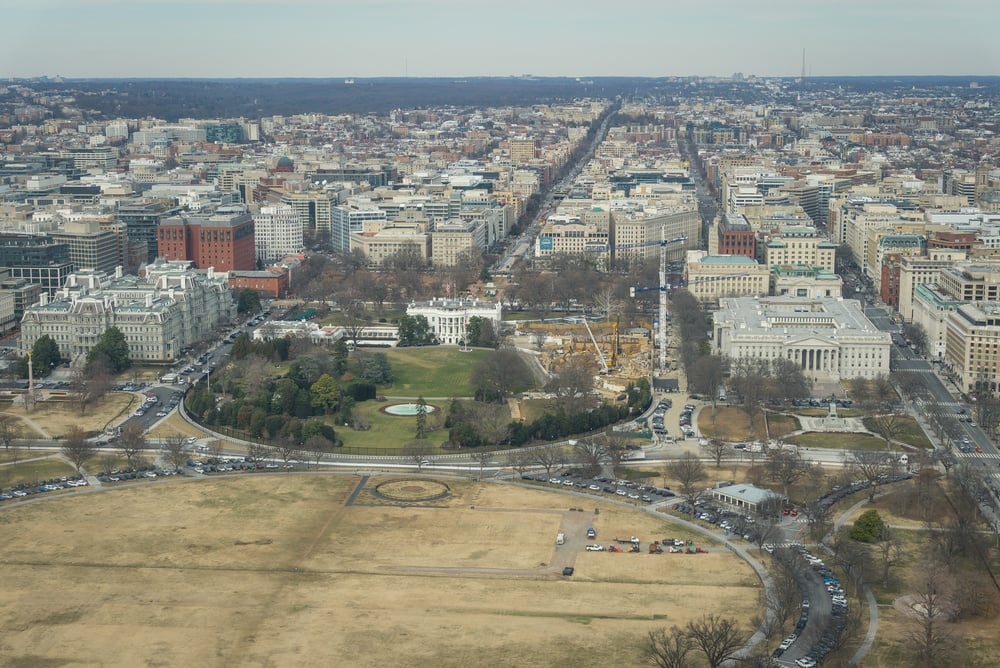
The fight over Trump’s White House ballroom is not about whether the project is a good idea, historic, or even secure. It is about a more basic question: Can the President build it without Congress signing off?
The U.S. Supreme Court has now allowed construction to continue while that question remains unresolved. In an emergency ruling, the Court did not decide whether the project is legal. Instead, it concluded that the preservation group challenging it likely lacked the kind of personal injury required to bring the case in federal court.
What Is Being Built?
As has been widely reported, the project replaces the former East Wing altogether. The federal government began the replacement project in October 2025, demolished the old East Wing by December 2025, and then began construction of a new East Wing complex. The new project includes a below-ground military installation and an above-ground ballroom.
The government says the two parts cannot be separated so easily. In its view, the project is one integrated whole: The ballroom’s proposed height and mass are needed to shield the underground installation from impacts and make it work as designed. The administration also says the completed complex would provide better security for the President, White House staff, and visitors at large official events.
But the National Trust for Historic Preservation doesn’t agree. The group argues that whatever national-security features may be underground, the government can’t just build a new ballroom on President’s Park because POTUS wants one.
The Lower Courts Stopped It
The National Trust filed suit in federal district court in December 2025. It sought to halt the overall project, but the later preliminary-injunction litigation focused on stopping construction of the new East Wing after the old one had already been demolished. Its central point is that Congress must expressly authorize construction of a building or structure on a federal reservation, park, or public ground in Washington, D.C. And according to the Trust, Congress never did.
In March 2026, the federal district court in Washington, D.C., issued a preliminary injunction. The court did not slam the brakes on the entire project. In a later clarified order, it allowed the government to continue below-ground construction and any work strictly necessary to protect the White House, the President, staff, and the construction site.
But the ballroom above ground? That was a different story. The injunction barred further construction. The government appealed, and the D.C. Circuit put the injunction on ice on April 17 while it considered the case. On August 7, however, the appeals court affirmed the injunction and said its temporary pause would expire on August 21. That put the administration on a clock. With the stop-work order about to kick in, the government headed to the Supreme Court seeking emergency relief.
Supreme Court Steps In
In an unsigned per curiam opinion, SCOTUS granted the government’s request to stay the injunction. As is typical, no justices signed the majority order, while the four dissenting justices did.
In practical terms, the restriction on above-ground ballroom construction is now paused, allowing the project to continue while the government prepares a petition asking the Court to review the D.C. Circuit’s decision.
The Court focused on standing, pointing out that a person or organization cannot bring a federal lawsuit simply because it believes the government acted unlawfully. Under Article III of the Constitution, a plaintiff must show an injury that is concrete, particularized, and actual or imminent.
In its legal argument, the National Trust had relied on the claimed injury of one of its members, Alison K. Hoagland. Hoagland, who lives in Washington, D.C., said she expects to visit the neighborhood around the White House about once a month. She alleged that seeing the ballroom would harm her “aesthetic, cultural, and historical interests” because she “finds the scale, height, and massing of the government’s design distasteful.”
But the SCOTUS majority concluded that this was not enough. It treated Hoagland’s alleged injury as offense, disagreement, or distaste about the ballroom’s appearance — not a concrete and particularized injury that permits a federal lawsuit. The Court cautioned that recognizing standing on that basis could effectively let citizens sue over nearly any government project they dislike.
Security Concerns Carried Weight
The SCOTUS majority also concluded that the government would likely suffer irreparable harm without a stay.
The government had submitted declarations from national-security and law-enforcement officials asserting that the project could not readily be divided into separate underground and above-ground pieces. The officials said that stopping construction could impair Secret Service protective operations, delay infrastructure necessary to make the underground facilities operational, create problems involving the integrity of a partially completed structure, and increase the risk of foreign actors gathering intelligence about the project.
The Court found that those asserted national-security and construction harms outweighed the aesthetic harm claimed by the National Trust’s member.
However, the majority did stress that its decision was not a ruling on the project’s legality. It held only that the government was likely to succeed in showing that the National Trust lacks Article III standing and that the other stay factors favored the government.
The Chief Justice Dissented
Chief Justice John Roberts dissented, joined by Justices Sotomayor, Kagan, and Jackson. Again, these are the three liberal justices and the moderate chief justice.
Roberts argued that Hoagland did have a concrete and particularized aesthetic injury. He emphasized that she is a historic-preservation scholar, a longtime National Trust member and executive committee member, and a Washington resident who regularly visits the White House to view and appreciate its architecture. The dissent argued that Supreme Court precedent acknowledged that a “pure esthetic” (sic) harm was enough to provide standing.
The dissenters also concluded that the ballroom project is likely unlawful. They reasoned that Congress has explicitly prohibited building on federal park grounds in Washington without express authorization, and that neither the White House maintenance-and-improvement statute nor the National Park Service’s general management authority supplies it.
The dissent’s bottom line was that the majority allowed construction to go forward based on standing – not because it held that the administration has legal authority to build the ballroom.
What Happens Next?
Construction can proceed for now, including above-ground work on the ballroom. The government will probably file a petition asking the Supreme Court to review the D.C. Circuit’s decision.
If the government timely seeks SCOTUS review and the Court denies it, the stay ends automatically. If the Court grants review, the stay remains in effect until the Court sends down its final judgment.
So, even as White House workers put their hard hats back on, we still don’t know if the construction is lawful.