
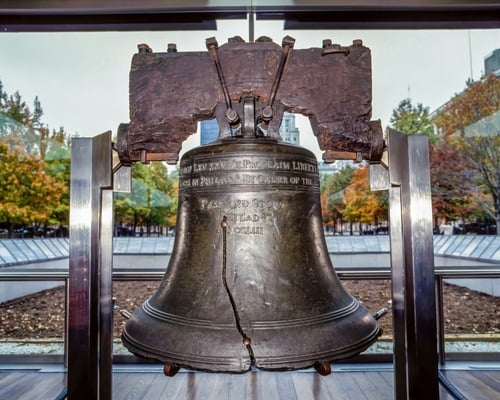
Sean Gerlach and Dawn Hawa don’t need to ask for whom the bell tolls. As the U.S. Department of Justice (DOJ) was happy to tell them, it tolls for vandalism. To spread the word, the department issued a press release rather than ringing a beloved (but extremely fragile) symbol of America’s freedom.
On November 2, 2026, the Justice Department announced that Gerlach, a North Carolina resident, and Hawa (also known as Dawn Benitez) had each been charged by information over their alleged actions on May 16. The incident involved Philadelphia’s Old State House Bell, better known as the Liberty Bell. According to court documents, Gerlach climbed over a barrier and pushed the Liberty Bell until it swayed several times. He faces charges of trespassing and tampering with property in a National Park. Hawa, who allegedly flicked an “oily substance” onto the Liberty Bell, is charged with vandalism of property in a National Park.
Wait, It Was Made Where?
The Liberty Bell is one of the nation’s most prized symbols of American independence. Originally cast in England (yes, really), it arrived in Philadelphia in 1752. It cracked the first time it was used, so a pair of local founders recast it. The recast bell didn’t crack, but its sound was deemed unsatisfactory. A second recasting improved the sound, but Pennsylvania’s legislature ordered another bell from England, which was installed on the roof of the Pennsylvania State House, later known as Independence Hall. The bell that would become the Liberty Bell was instead used to call the Assembly.
To prevent approaching British forces from melting it down for munitions, the Liberty Bell was evacuated from Philadelphia in 1777. It spent nine months concealed under the floorboards of a church in what would become Allentown, returning to Philadelphia after the British retreated in 1778. Philadelphia later acquired the bell as part of its purchase of the State House, which Pennsylvania no longer needed. The Liberty Bell’s replacement was recast and spent many years at Villanova University before returning to St. Augustine’s Church in Philadelphia in 2022.
While it was likely rung during the American Revolutionary War, the Liberty Bell didn’t become a symbol of freedom until 19th-century abolitionists gave it its name. Several likely apocryphal stories explain when it first cracked. One claims it happened in 1835 while the bell was ringing to announce the death of Chief Justice John Marshall. No one has verified the original crack’s actual cause. The familiar wide opening resulted from an attempted repair in 1846.
The Liberty Bell toured the nation between 1885 and 1915. After World War II, Philadelphia granted the National Park Service (NPS) custody of the bell. It moved from Independence Hall to a nearby glass pavilion in 1976, then settled in its current home at the Liberty Bell Center in 2003.
Your Field Trip Teacher Was Right
Protective barriers aren’t just suggestions. At national parks, federal regulations prohibit trespassing into areas closed to the public, tampering with property, and vandalism. Moving a protected object can raise legal issues even without visible damage. While the waist-high barriers around the Liberty Bell are enough to keep millions of visitors from trying to ring it, prosecutors allege that Gerlach crossed the barrier and pushed the Liberty Bell hard enough to make it sway.
If convicted, Gerlach is facing up to a year in federal prison on counts of tampering and trespassing. For her vandalism charge, Hawa could receive up to six months.
Admire the history, take a photo where permitted, and leave the hands-on work to the conservators. Whether you’re visiting the Liberty Bell or browsing a local museum, “look, don’t touch” is more than a reminder from your school field trip.


