
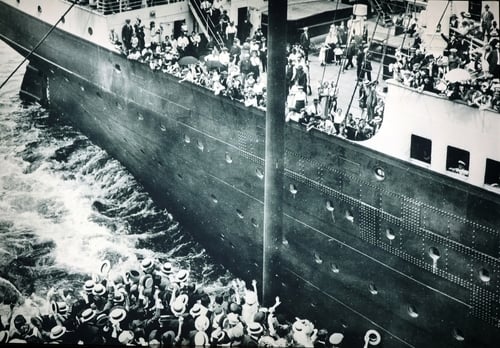
In the century since the Titanic sank in 1912, the world has never lost its fascination with the tragedy. After the wreck’s rediscovery in 1985, salvage efforts could finally begin. Yet the recovery of artifacts salvaged from the Titanic has been dogged with controversy, both legal and ethical.
Since 1993, the wreck of the Titanic has been in federal court as the subject of an in rem proceeding: that is, a case to determine property rights in the wreck. The company R.M.S. Titanic, Inc. has held exclusive salvage rights to artifacts removed from the Titanic. Those rights are not absolute; they are subject to federal law, international treaty, and agreements with the U.S. government. The French government has also asserted its interest in over a thousand artifacts that R.M.S. Titanic, Inc. holds.
Recently, senior U.S. District Judge Rebecca Beach Smith placed a hold on the company’s proposed auction of Titanic artifacts. Both the U.S. government and the French government, along with a number of scientists and historians, have raised doubts about whether the sale could be in the public interest — or even legal. The court has now ordered a report on the inventory and condition of the Titanic artifacts, many of which are fragile and need expert care.
Salvaging the Titanic: The French Collection
Despite the best efforts of the stakeholders, there was no way to salvage the Titanic with the technology available in the 1910s. No one could even confirm where the shipwreck lay amid the vast North Atlantic search area. It wasn't until 1985 that oceanographer Bob Ballard could finally pinpoint the Titanic, with backing from the U.S. Navy and IFREMER, the official French oceanographic institute.
A subsequent 1987 expedition involving IFREMER and Titanic Ventures LP recovered about 1,800 artifacts and took them to France for conservation work. These items would later become known in court as “the French Collection.”
George Tulloch, then head of Titanic Ventures, wrote to the French government in 1993 to seek legal ownership of the artifacts. Tulloch stated that “in memory of their initial owners,” the company would use them only for cultural purposes, and would not disperse or sell the collection. The French maritime authority then issued a formal written understanding, stating that Titanic Ventures had French salvage rights to these artifacts. But as it did so, it emphasized “your intention … by which you agreed to make use of such objects in conformity with the respect due to the memory of their initial owners and to not carry out any commercial transaction” that would sell or disperse the collection.
The Work Undersea and In Court
Titanic Ventures then sold its interests to R.M.S. Titanic, Inc. (RMST), which today describes itself as “the official steward of Titanic’s legacy.” As it continued salvage work, RMST filed an admiralty action in the U.S. District Court for the Eastern District of Virginia, seeking to secure its salvage rights in the shipwreck. That case docket has been open from 1993 to this day.
In 1994, the court recognized RMST as salvor-in-possession, giving it the exclusive right to conduct salvage operations at the wreck. In 2011, the court awarded RMST title to the Titanic artifacts it had recovered as compensation for its salvage work. RMST has salvaged about 5,500 items since it began. However, that title is subject to Covenants and Conditions that govern the artifacts’ care and regulate any sales that RMST may undertake. This agreement provides that NOAA (the National Oceanic and Atmospheric Administration) is responsible for representing the U.S. public interest in the Titanic.
The original RMST had what might be called a colorful history, involving hard corporate maneuvers and unrelated ventures; it filed for bankruptcy in 2016. Private equity investors purchased the company in 2018. RMST retains its rights today, but it also retains the obligations.
Can RMST Auction Its French Artifacts?
This March, RMST advised the court that it intended to auction about 100 lots of artifacts from the French Collection, retrieved from the ship in 1987. Buyers would be able to choose among vases, kitchenware, currency, and jewelry, including a bracelet engraved with a woman’s name. RMST claimed that its current “financial difficulties” require it to hold the auction so that it can preserve the rest of the Titanic collection. It also asserted that the court had no jurisdiction over the French Collection, and that the agreed-upon Covenants and Conditions did not apply to those items.
NOAA promptly objected, stating that RMST could not “avoid its agreed responsibilities to this Court” by breaking up the Titanic collection. Indeed, France itself sent word, as the court’s opinion states. The French Embassy expressed “deep concern and opposition” to the auction plans, as they violated the French government’s 1993 understanding that the collection would remain together and serve “cultural purposes” only.
In her lengthy opinion and order, Judge Smith noted “the many letters [the court] has received from persons and organizations across this country and Europe in unanimous and eloquent opposition to the auction”: underwater archaeologists; museum representatives; Titanic historians; and more. Most importantly, she determined that the court did in fact have authority over the French Collection.
As such, the court enjoined the auction. No such sale can take place until RMST has provided a “complete and satisfactory” inventory, followed by a report and recommendation from NOAA. Only then can it decide whether to approve any sale of Titanic artifacts under the letter and spirit of the standing agreements.


