Chicago Cubs fans had to be disappointed by the club’s quick exit from the Wild Card round of the Major League Baseball (MLB) playoffs last week. While the Ricketts Family, who own the team, were likely also dismayed by the ouster at the hands of the San Diego Padres, they may take some solace from a victory won away from Wrigley Field.
On September 30, 2026, a federal judge in the U.S. District Court for the Northern District of Illinois granted partial summary judgment and injunctive relief to the Cubbies in Chicago Cubs Baseball Club LLC v. Aidan Dunican and Rooftop by the Firehouse, Inc. (d/b/a Wrigley View Rooftop), preventing the rooftop business from continuing to sell tickets for bleacher seating that allows its ticketholders to view events taking place at Wrigley Field. U.S. District Judge Sharon Johnson Coleman ruled that the rooftop business misappropriated the Cubs’ live-game experience and was unjustly enriched by selling tickets without contributing to the cost of producing the games. She also found trademark infringement based on its continued unauthorized use of Cubs marks after its licensing agreement expired.
It seems fitting that, for one of America’s oldest games, Judge Coleman’s decision leaned heavily on an 88-year-old precedent in Pittsburgh Athletic Club v. KQV Broadcasting Co. While rooftop views of Cubs games and other events at Wrigley Field have been available for decades, fans will have to find another venue with a view to enjoy their peanuts and Cracker Jacks next season.
The “Curse of the Billy Goat” Wasn’t Real (or Was It?)
Founded in 1870 as the White Stockings, the Chicago Cubs adopted their current name in 1903. After winning the World Series in 1907 and 1908, it would take the Cubs and their passionate and long-suffering fans 108 years to become champions again. With an estimated value of $4.6 billion, the Cubs rank among the top five most valuable MLB teams. The Ricketts family has owned them since 2009 and operates them through the parent company Chicago Baseball Holdings, LLC.
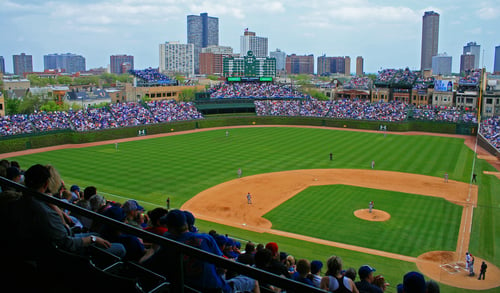
The Cubs play their home games at Wrigley Field, which opened as Weeghman Park in 1914. This makes it the second-oldest field still in use, surpassed only by Fenway Park, home of the Boston Red Sox, which has been in use since 1912. Nicknamed “The Friendly Confines,” it was designated as a National Historic Landmark in 2020. It didn’t add lights for night games until 1988. Its location in a residential neighborhood gives it something few other baseball stadiums have: neighbors with a view.
While nearby tall buildings had long given locals a free vantage point for Cubs games and other events at the open-air stadium, it wasn’t until the early 1990s that rooftop owners formed businesses to begin charging for views from beyond the right-field bleachers. Operations such as the Lakeview Baseball Club, Skybox on Sheffield, and Right Field Rooftops, LLC built their own grandstands with full or partial views into Wrigley, some with the capacity to host hundreds of fans. While fans may not have been able to see the famed manual scoreboard or the newer video boards from their particular perch, the venues provided a unique viewing experience.
Before the Ricketts purchased the team in 2009, the Cubs' owners entered into a settlement agreement with the rooftop venues, including Wrigley View Rooftop. In exchange for 17% of gross revenue and 11% of billboard income, the licensing agreement allowed the venues to continue selling tickets and advertising that they were endorsed by the Cubs. This included the use of brand-specific Cubs marks, such as the team’s logo, on websites and advertising signs.
Before the agreement expired on December 31, 2023, the Cubs offered a new deal that increased the rate the venues would have to pay. While most accepted the increase and signed the new agreement, Wrigley View Rooftop did not. That didn’t stop Dunican and Wrigley View Rooftop from continuing to sell tickets for Cubs games, even after a 2024 expansion of Wrigley Field that included four semi-transparent mesh screens installed to obstruct the view. Alleging misappropriation of their product by Wrigley View Rooftop for unjust enrichment and other claims, the Cubs filed a lawsuit on June 18, 2024.
Not a Sweep, but Still a Series Win
In Pittsburgh Athletic Club, the Pittsburgh Pirates sued a radio station that installed staffers on rooftops with a view of the field to deliver an unauthorized, unlicensed broadcast of the team’s games. The Pirates successfully argued they created the product on the field at great financial expense and thus had the right to demand viewership come from paying customers or licensed outlets.
Given that there was “no genuine dispute” that the Cubs (and other performers within the confines of Wrigley Field) bore the cost of putting a product on the field, Judge Coleman agreed with the plaintiffs that Wrigley View Rooftop was indeed gaining unjust enrichment and engaging in unfair competition by selling tickets to something for which they bore none of the production costs (in court filings, the Cubs referred to Wrigley View Rooftop as “parasitic”). Coleman acknowledged that not every rooftop customer would otherwise have purchased a Wrigley Field ticket. Still, she concluded that Wrigley View diverted at least some revenue that would have reached the Cubs through stadium ticket sales or royalties paid by other rooftops. Average ticket prices for a Cubs game range between $55 and $117, and Wrigley View Rooftop offered seating for up to 200 on game day.
She also ruled that Dunigan was liable for trademark infringement because he failed to remove all of the Cubs’ marks and endorsements from Wrigley View Rooftop’s website and promotional literature. However, Judge Coleman denied the Cubs’ false advertising claim. Although their continued claim to be an “Official Partner of the Cubs” was false, the Cubs failed to provide evidence that the statement was likely to influence customers’ purchasing decisions
Those who want to watch a Cubs game from a rooftop will have to find a different venue. The permanent injunction Judge Coleman issued blocks Dunigan from using Cubs trademarks, implying that Wrigley View Rooftop is affiliated with the team, or selling tickets to customers when the club is playing. Unless Dunigan opts to swing for the fences in the Seventh Circuit Court of Appeals, this ballgame is over. As for dejected Cubs fans, well, 2027’s Opening Day at Wrigley against the Guardians is on March 27.