
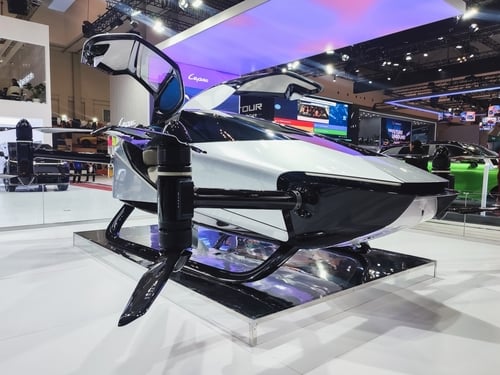
It feels like we’ve been waiting around for our flying cars since the days of “Chitty Chitty Bang Bang” and “The Man With the Golden Gun.” Could the October 15, 2026, reveal of Tesla’s “flying” car finally mean your morning commute will soon have you zipping above your groundbound brethren?
Well, it might be wise to temper both excitement and expectations, since “flying” does a lot of heavy lifting when describing the Tesla Roadster’s exploits. Still, the tantalizing glimpse at the long-promised future poses more than a few pertinent questions. If flying cars are on the horizon, will the Federal Aviation Administration (FAA), the National Highway Traffic Safety Administration (NHTSA), or the Department of Transportation (DOT) be tasked with regulating the new airborne roadways? Which will hold sway, local traffic laws or aviation laws? Is an electric vertical takeoff and landing aircraft (eVTOL) considered a car or a plane?
For this particular vehicle, the FAA has already offered an answer: It told Politico that the Tesla Roadster does not meet its definition of an aircraft. DOT said the vehicle must comply with applicable federal motor vehicle safety standards and that drivers must obey local traffic laws. But a vehicle designed for sustained flight and public-road driving would raise a different set of regulatory questions.
While it may seem (extremely) premature to consider these and other questions for a vehicle that isn’t currently in production and not approved for public road use, the possibility that actual flying cars may someday be street legal demands consideration of the potential ramifications and logistical necessities. If we get the opportunity, what will keep flying cars safe for drivers and everyone else?
Leeloo Dallas Multipass
Movies like “Blade Runner” and “The Fifth Element” made legions of flying cars flowing in orderly, logical traffic patterns seem mundane and normal. Although Elon Musk promised a flying Roadster as far back as 2018, it took until last week to provide a glimpse of what could be. While perhaps not exactly “flying,” the Roadster sports car used its cold-gas thrusters and downforce-generating fan system to briefly stay upside down, make a controlled descent, flip over, barrel-roll, jump over other Teslas, and hover.
While Tesla and other companies striving to create passenger versions of eVTOLs face a challenging task, the fact that someone could succeed raises the question of how that would play out. The DOT, NHTSA, and state agencies regulate vehicles on roads. Aircraft, including everything from drones to planes, fall under the FAA's purview. Would a flying car fit the FAA definition of an aircraft, be regulated under federal motor vehicle safety standards, or some combination of both? What type of insurance would be required to legally operate such a vehicle, and would any insurance company be willing to provide coverage? Would federal laws be absolute, or would a mélange of state laws further complicate the issue? If the Roadster is any indication, “flight” may also need a more precise legal definition, since the SpaceX thrusters provided more of a “hop” than sustained airborne travel.
Given the potential for increased exposure and safety risks, the Department of Homeland Security (DHS) would also likely need to be included in any discussion. The public availability of flying cars could be delayed or blocked unless the military and federal, state, and local law enforcement had the means and authority to police or counter this potential threat. A car that could fly over protective fences and walls would present difficult security challenges, to say the least.
There’s also a significant gap between the requirements to drive a car and to fly a plane. For the most part, driver’s license qualifications include proper identification and passing both a written exam and a road skills test. For a private pilot license (PPL), applicants must complete an FAA medical exam administered by an Aviation Medical Examiner (AME), log at least 40 hours of flight time (at least 20 with a Certified Flight Instructor), and pass a written knowledge test. They must also pass a practical test consisting of an oral portion and a flight portion administered by an FAA examiner. Those planning to use their flying cars as a taxi should be aware that PPL holders aren’t permitted to be paid for a flight.
Other concerns would need to be hashed out to keep the airspace as safe as possible. The FAA has established altitude minimums and restrictions for aircraft over populated areas. Would those apply? Given that the Roadster’s current compressed-air system would severely limit how high (and for how long) the vehicle could feasibly go, new rules would need to be created. Would those be drafted by the FAA, the DOT, or state agencies? The sight of the Roadster briefly defying gravity can send imaginations soaring, but the reality of flying-car concerns can bring things crashing back to earth (hopefully just metaphorically).
This Way to the Egress?
After years of unfulfilled promises, the Roadster’s performance can spark hope in those waiting for the advent of flying cars. It should also promote discussion on what could be the opening of a legal and administrative can of worms if such airborne vehicles do become available. There’s some speculation that the unveiling was more of a P.T. Barnum-like bit of razzle-dazzle to distract from Musk’s goal of merging Tesla with SpaceX and shifting from electric vehicles to fully self-driving “Cybercabs.”
Even if the Roadster goes into production, meeting whatever requirements are instituted on state and federal levels won’t be a concern for most people. While the “Performance” level of the new Roadster is reportedly $50,000 and the “Thrust” model is available for $250,000, the one that “flies” is in a different pricing stratosphere. The “Rocket” version is invite-only and doesn’t reveal the price. The idiom “If you have to ask, you can’t afford it” feels particularly accurate.


