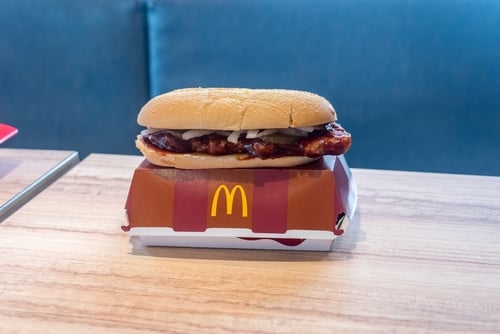
Order a McRib sandwich, expect rib meat. Is that a reasonable assumption, or are you reading too much into a sandwich? Four McDonald’s customers say they have a bone to pick with the fast-food chain over exactly that question.
McDonald’s asked a federal judge to throw out the customers’ lawsuit, but most of their claims are still on the menu. Before we get into the meat of the ruling, though, it helps to understand what the customers had to show, and why clearing this hurdle isn’t the same as winning.
The Rib Is the Rub
In their amended complaint from earlier this year, the customers allege that McDonald’s sells the expectation of premium rib meat through more than the McRib name: The patty resembles a rack of ribs, and the advertising and price reinforce that impression.
But the plaintiffs allege that the patty contains no rib meat. Instead, they say, it is made from lower-grade pork products, including heart, shoulder, and stomach. These are ground up and formed to resemble a rack of ribs rather than cut from one.
Each plaintiff says they bought the sandwich in late 2024 believing that it contained rib meat. They say they would not have bought the McRib at its advertised price had they known otherwise. Their claims center on alleged false representations and deceptive marketing, and include fraud, violations of state consumer protection laws, and breach of warranty. The complaint also seeks class-action status, which would allow the plaintiffs to pursue claims on behalf of other customers.
McDonald’s disputed the deception theory. It argued that it accurately describes the sandwich as containing boneless pork and never promises a particular cut. It asked the court to dismiss the case on the ground that the allegations did not state legally sufficient claims.
A Motion to Dismiss Isn’t a Trial
McDonald’s invoked Federal Rule of Civil Procedure 12(b)(6), which allows defendants to seek dismissal for failure to state a claim upon which relief can be granted. In everyday language: Even taking the properly alleged facts as true, has the plaintiff described something the law provides a remedy for?
As U.S. District Judge April M. Perry explained in her opinion and order, this motion tests the complaint’s sufficiency, not its merits. Courts accept well-pleaded factual allegations as true and draw reasonable inferences in the plaintiffs’ favor, but legal conclusions require factual support. Simply accusing a company of fraud won’t suffice.
The key is plausibility: under the Supreme Court’s Twombly and Iqbal decisions, the complaint must contain enough factual detail to support a reasonable inference that the defendant is liable. Plaintiffs don’t have to prove their case yet, but speculation and a checklist of legal elements won’t cut it.
Why These Allegations Were Enough
For the consumer protection claims, a central question was whether the McRib’s marketing could mislead reasonable consumers. Although courts can dismiss claims based on unreasonable or fanciful interpretations of advertising, Perry wasn’t persuaded that expecting rib meat fell into that category.
McDonald’s emphasis on its literally accurate description (pork) didn’t settle the issue because advertising can convey misleading implications even when its express statements are true. The customers weren’t claiming they expected something other than pork; they claimed they expected pork from a particular part of the animal.
The plaintiffs also pointed to surveys suggesting their interpretation wasn’t unusual. Asked about the McRib’s contents, 72% of participants in one survey anticipated rib meat. A separate survey addressed whether that ingredient mattered: Roughly two-thirds rated its presence as important or very important when considering a purchase. McDonald’s questioned how the surveys were conducted, but Perry declined to assess their reliability on a motion to dismiss. That wasn’t an endorsement of the results; their reliability remained a factual issue to be tested.
Fraud Requires More Detail
Claims sounding in fraud face an additional requirement under Rule 9(b): Plaintiffs ordinarily must describe the who, what, when, where, and how of the alleged deception. Knowledge and intent may be alleged generally, but still need a plausible factual basis.
McDonald’s argued that the plaintiffs hadn’t adequately alleged that the company knew its representations were false or intended to induce purchases. But the plaintiffs alleged that McDonald’s controlled the sandwich’s recipe and marketing, and pointed to advertisements emphasizing the patty’s rib-like shape. Perry found those allegations sufficient to proceed, while emphasizing that proving fraudulent intent would require more. In other words, alleging fraud plausibly isn’t the same as proving it.
Some Claims Still Got Dismissed
A plausible deception theory doesn’t automatically save every claim attached to it. Perry dismissed four contract-based claims because the plaintiffs failed to meaningfully address McDonald’s legal arguments. Their response focused on consumer perceptions without adequately explaining the contractual basis for recovery, so the court treated those undeveloped arguments as waived.
The negligent misrepresentation claim failed for a different reason. Under the Illinois law the court applied, recovery for these purely economic losses required a duty associated with supplying information for others’ business transactions. McDonald’s sells food, and its product descriptions were incidental to those sales, so that exception didn’t apply.
The court dismissed all 5 claims without prejudice, leaving an opportunity to seek amendment. Separately, the court rejected the requested injunction against future marketing: Now aware of the alleged deception, these plaintiffs hadn’t plausibly alleged the threat of future harm needed to seek that relief.
What Happens Now?
McDonald’s must still defend against allegations of deceptive practices and fraud, along with the plaintiffs’ unjust enrichment theory. But the ruling neither awards compensation nor establishes that the case qualifies for class treatment. The customers have met an initial pleading requirement; proving liability and obtaining class certification remain separate challenges. For now, they’ve kept their case alive, not secured a refund.