A park ranger can investigate a crime. But can that ranger also act as the prosecutor? That’s the question behind a legal challenge by Jack Propeck, who faces a federal charge for allegedly parachuting off Yosemite’s Glacier Point in 2025. A local rule of California’s Eastern District federal court allows National Park Service (NPS) rangers to file criminal charges and negotiate plea deals for illegal acts allegedly committed within the parks’ borders under Department of Justice (DOJ) supervision. Propeck argues that rangers went beyond assisting federal prosecutors and made plea-bargaining decisions themselves.
After the court denied his motion to disqualify the Park Rangers from acting as prosecutors in his misdemeanor petty offense in September 2026, Jack Propeck filed a motion to reconsider the order through his assistant federal defenders on October 2, 2026.
What Is a Park Ranger’s Authority in Yosemite?
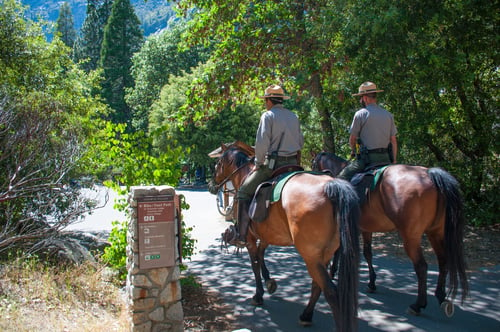
As part of the Department of the Interior, NPS agents serve as law enforcement in federal territory designated as national monuments and parks such as Yosemite and Yellowstone National Park. Known for keeping the federal properties safe and assessing fines, National Park Rangers also have jurisdiction to arrest offenders for crimes ranging from cultivating marijuana to vandalism.
Each U.S. District Court has its own set of rules. Rule 180(b)(4) of the Eastern District of California permits a federal agency or department to assign one of its officers, agents, or employees to appear as a prosecutor on its behalf, provided the individual has performed four or more hours of training with the USAO within the previous two years. The rule further requires the USAO to act in a supervisory role.
A Visit to Remember
Yosemite National Park in California is one of the NPS’s brightest jewels, with 4.28 million visitors in 2025. It boasts sights such as El Capitan and Yosemite Valley. One of those guests was Propeck, who was charged by United States Park Ranger Cody Hays for allegedly BASE-jumping off Glacier Point in October 2025 and using a parachute, which is illegal on federal lands. Ranger Hays said an anonymous tip led him to a video posted on Propeck’s social media site showing the leap, with the jumper wearing a distinctive wingsuit and sunglasses also seen in other posted videos. His reasonable suspicion led to probable cause after FBI data allowed him to confirm the presence of Propeck’s vehicle in Yosemite at the time of the jump.
Propeck claimed the video wasn’t of him, even though it appeared to be. Propeck later claimed he’d used artificial intelligence to superimpose his face onto the actual jumper. Ranger Hays filed a criminal complaint against Propeck on December 12, 2025.
Can a Park Ranger Make a Plea Deal?
According to Propeck’s reconsideration motion, NPS rangers drafted, communicated, and negotiated a plea offer that recommended an 18-month sentence. Other details were not released. In July 2026, Propeck filed a motion to disqualify the NPS from serving as prosecutor on statutory grounds, but U.S. Magistrate Judge Helena M. Barch-Kuchta denied it on September 15, stating that Rule 180 was not facially invalid and that Propeck had not proven there was an impermissible delegation of prosecutorial authority by the USAO.
Propeck’s reconsideration motion seeks to supply what the judge found missing from his earlier challenge: evidence that NPS rangers independently exercised prosecutorial discretion. His lawyers argue that the fuller email exchange and a former Yosemite legal officer’s declaration show that DOJ did more than allow rangers to communicate decisions made by federal prosecutors — it allowed them to make those decisions themselves.
His motion also cites an email between his counsel and the assigned assistant U.S. Attorney (AUSA), in which the AUSA responds to a question about the plea with “What did [the Rule 180 NPS representative] say his understanding was? If he said 18 months then that’s the position.” Propeck claims this shows the AUSA was not acting in a supervisory role and hadn’t established the government’s position in the ranger’s offer. It also cites a former Yosemite Legal Officer who states that he was “authorized to extend plea offers and negotiate terms” he found “fair and equitable without any consultation.”
Propeck’s motion for reconsideration doesn’t guarantee a soft landing, of course, but he’s apparently willing to take another leap at it.