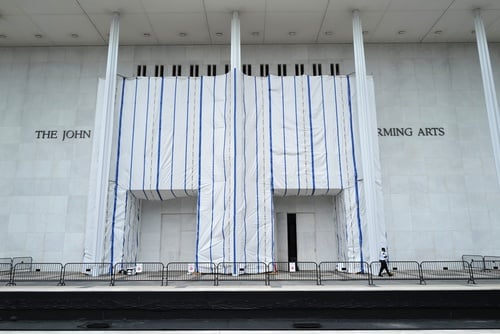
Washington’s John F. Kennedy Center for the Performing Arts presents theater, music, dance, and other performances. It also has an unusual leadership arrangement: Donald Trump serves as both U.S. president and chairman of its board.
Those roles are now colliding in litigation over the institution’s name and proposed renovation closure. The administration says executive privilege protects some of the communications sought in the case. The question is how far that presidential protection reaches into the business of running an arts center.
A Court Fight Moves Behind the Scenes
Ohio Rep. Joyce Beatty sits on the Kennedy Center’s board and opposes the proposed closure and addition of Trump’s name. Her lawsuit seeks to stop those changes, and she is using the evidence-gathering process to examine Trump’s part in the decisions.
The administration has resisted some of those requests. In an October 14 declaration, White House Deputy Counsel Joshua Hoyt says Trump directed him to invoke the presidential communications privilege. According to Hoyt, the government has already relied on that privilege to withhold information.
His assertion covers more than direct exchanges with Trump. It also encompasses discussions among advisers and Kennedy Center employees who gathered information for presidential recommendations or conveyed Trump’s decisions. Hoyt identifies particular document requests and deposition questions, some involving Secretary Howard Lutnick, as falling within that protection.
The practical effect is twofold: withholding written material and preventing testimony that would disclose the same communications. Hoyt’s declaration lays out the administration’s position; it does not resolve whether that position is legally justified.
What Does Executive Privilege Actually Protect?
“Executive privilege” is an umbrella term for several protections against disclosing executive branch information. One is the “deliberative process privilege,” which generally protects internal government discussions preceding a decision.
Hoyt relies on a different protection: the “presidential communications privilege.” Rooted in the constitutional separation of powers, it allows presidents to receive confidential advice. His declaration argues that the prospect of disclosure would discourage advisers and their staffs from doing the work necessary to develop sound recommendations.
The presidential privilege is stronger in important ways. Unlike the deliberative process privilege, it can protect entire documents, including factual material, and communications made after a decision. So Hoyt’s inclusion of messages communicating Trump’s decisions is not automatically a legal overreach.
Establishing that a communication falls within the privilege is only part of the analysis. A sufficiently strong need for the evidence can sometimes outweigh the confidentiality interest. Courts therefore distinguish between whether the privilege applies and whether it can be overcome.
President or Board Chairman?
The Kennedy Center’s structure complicates the first question. Federal law assigns the duty to maintain and administer the Center to its board. Separately, it gives the president authority to appoint general trustees and designate members of an Advisory Committee on the Arts. The presidency itself does not automatically make its occupant the board’s chairman; the statute provides for the board to select its chair from among its members.
Paragraph 13 supplies Hoyt’s explanation for treating Center business as presidential business. Selecting trustees and arts advisers, he argues, requires an informed view of the institution they will serve. He therefore links discussions of its operations, cultural activities, and finances to Trump’s appointment responsibilities, arguing that those responsibilities overlap with his board role.
That connection could support protection for advice genuinely informing appointment decisions. For example, an assessment prepared to help Trump evaluate a prospective trustee presents a different privilege question from a routine operational exchange among Center employees. Appointing trustees does not necessarily turn every discussion about their institution into presidential business.
Beatty’s lawyers argue that Trump is a defendant as board chairman, not as president. Neither the lawsuit’s label nor Hoyt’s claim of overlapping duties settles the issue. The substance and purpose of the communications matter.
How Far Can the Protection Travel?
The claim’s reach raises another question: Whose communications qualify? Trump’s absence from a conversation does not necessarily defeat privilege. In In re Sealed Case, the D.C. Circuit extended protection to certain communications involving immediate presidential advisers and their staffs preparing advice for the president. But it cautioned against extending that protection too far down the chain.
Protected advisers can obtain information from outside sources, but that does not automatically protect every internal discussion those sources have. A later case illustrates the limit. In Judicial Watch v. Department of Justice, the court rejected presidential privilege for internal Justice Department pardon documents that were not “solicited and received” by the president or his immediate White House advisers. Even work concerning the president’s exclusive pardon power did not automatically qualify.
That distinction puts pressure on Hoyt’s broad references to Kennedy Center staff and nongovernment advisers. The administration needs to connect the withheld exchanges to the protected presidential advisory process, rather than simply to the Center’s “management and operation.”
Importantly, falling outside this particular privilege does not necessarily mean a document must be disclosed. In Judicial Watch, the court sent the case back to consider the separate deliberative process privilege. Hoyt similarly reserves the possibility that other privileges protect the Kennedy Center materials, without specifying them in this declaration.
Does Watergate Settle It?
Even if the communications qualify, that does not necessarily end the inquiry. United States v. Nixon rejected absolute presidential confidentiality and required disclosure of evidence needed for a criminal trial.
But Beatty’s case is civil, and in Cheney v. United States District Court, the Supreme Court emphasized that civil discovery presents a different balance. The constitutional need for evidence in a criminal prosecution carries particular weight, and Nixon did not resolve how that balance works in civil litigation.
The Cheney Court also stressed that judges can narrow overly broad discovery requests to avoid unnecessary intrusions into presidential decision-making. That means the options are not limited to ordering everything disclosed or accepting a sweeping confidentiality claim. The scope of the requests matters, too.
In sum, the fight over records is not the main event, but it could shape how the main event unfolds. What Beatty can uncover about the Center’s decisions may affect her ability to challenge them, making this dispute over access to evidence consequential for the institution’s future.