
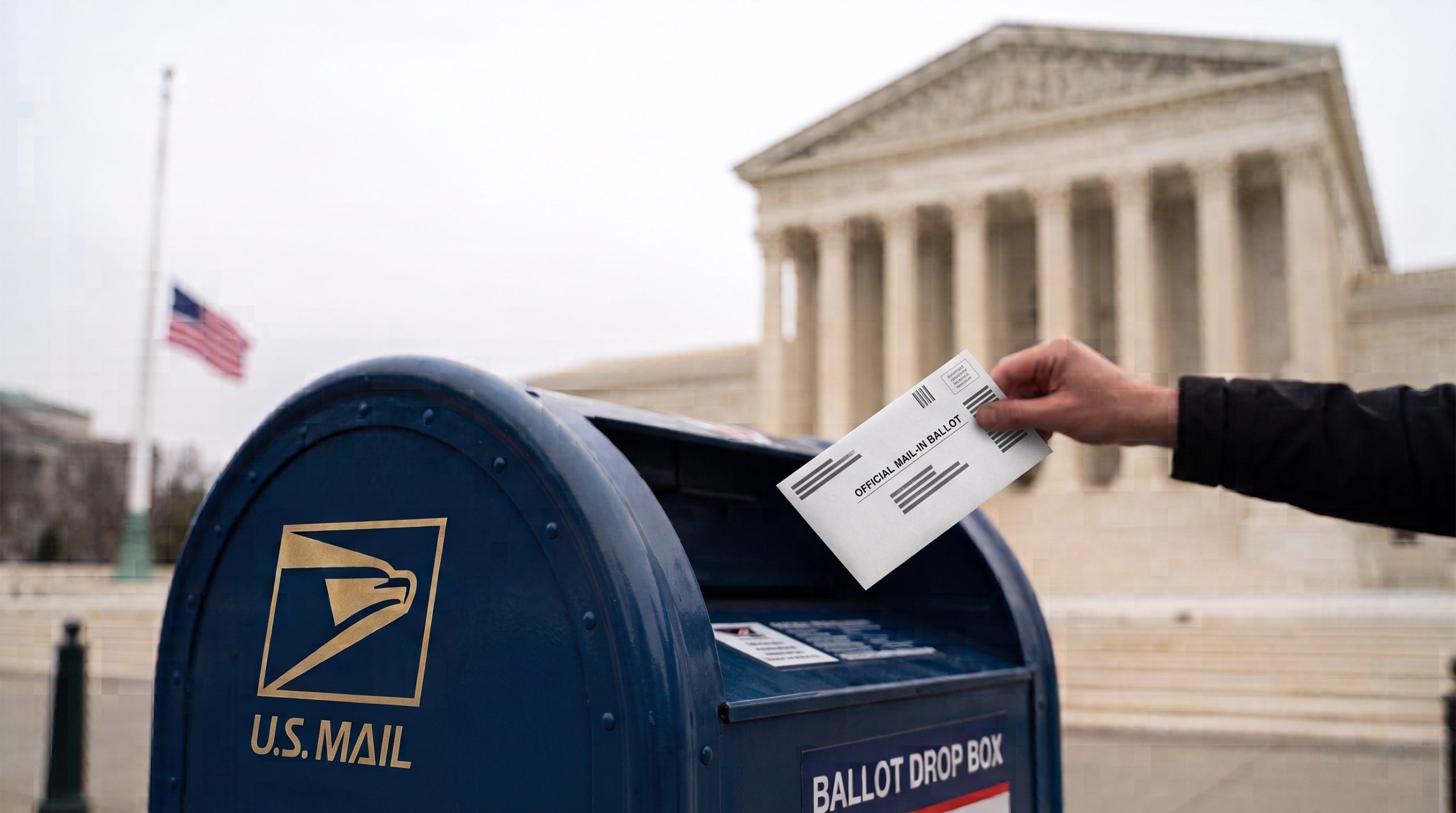
For over 180 years, absentee and mail-in ballots have been part of American political elections. For the 2026 midterms, a ruling by the U.S. Supreme Court (SCOTUS) leaves in place a preliminary injunction against new federal ballot-mail requirements imposed by the U.S. Postal Service (USPS). Beyond that, mail-voting restrictions will continue to be litigated in the nation’s courtrooms.
On September 14, 2026, SCOTUS denied an application to stay a preliminary injunction issued by a district court in League of Women Voters of Massachusetts v. Trump. In United States Postal Service v. California, the Court left in place an injunction blocking implementation of USPS’s August 2026 final rule on ballot mail for federal elections. The rule was promulgated after an executive order issued by President Donald Trump in March 2026, in which the administration cited election-integrity and fraud-detection concerns.
The final USPS rule would have imposed design and USPS-review requirements on both outbound ballot envelopes and return envelopes used in federal elections. Its portal-based verification and USPS acceptance requirements applied to outbound federal ballot mail—mail sent by state or local election authorities to voters. States or authorized ballot mailers would have had to use specialized ballot envelopes, including unique barcodes capable of high-speed processing scans, and submit voter and mailing information through a USPS online portal. USPS could refuse to accept an outbound ballot mailing for delivery if it could not match the envelope’s barcode to the information submitted through the portal. Rejected mailings could be corrected and resubmitted by the state or authorized mailer. The rule did not govern USPS acceptance of completed ballots returned by voters to election offices.
While the decision does not contain a breakdown of how each Justice voted, the dissent written by Justice Samuel Alito and joined by Justice Clarence Thomas suggests a 7–2 split. In his concurrence, Justice Brett Kavanaugh wrote that there was “at least a fair prospect” that the final rule fell within USPS’s authority. But he concluded that applying it in the 2026 elections would be “arbitrary and capricious in violation of the Administrative Procedure Act” because state and local election officials lacked sufficient time reasonably to implement it. No other Justices joined his concurrence. Whether this shuts the door on attempts to restrict mail-in voting or kicks it open wider for more legal challenges remains to be seen.
Not Voting Is Disrespecting the Best of What This Nation Stands For
Voting by mail has been available since at least 1864, when Ohio created special envelopes for soldiers to mail their votes in the presidential election. While it slowly grew in popularity, absentee and mail-in voting were traditionally limited to people with a plausible excuse for not being able to vote in person on Election Day. That changed in 1978, when California became the first state to allow any voter to request an absentee ballot without giving an excuse. In the 2024 general election, mail voting comprised 30.3% of turnout.
Under President Trump, the White House has made numerous claims alleging widespread voter fraud in vote-by-mail ballots. Despite failing to present substantive proof of the suggested cheating, President Trump issued Executive Order 14399 on March 31, 2026. Titled “Ensuring Citizenship Verification and Integrity in Federal Elections,” it came in the wake of a similar order in 2025 that was blocked by three different federal courts.
EO 14399 directed the Department of Homeland Security (DHS), through U.S. Citizenship and Immigration Services and in coordination with the Social Security Administration (SSA), to compile and transmit “Confirmed Citizen Lists” to state election officials, to the extent feasible and consistent with applicable law, including the Privacy Act. The order directed the agencies to identify individuals who federal records confirmed were U.S. citizens, who would be at least 18 by the upcoming federal election, and who were residents of the relevant state. The lists were to be transmitted no later than 60 days before each regularly scheduled federal election.
Separately, the executive order directed USPS to propose a state-specific “Mail-In and Absentee Participation List” system. It contemplated that USPS would not transmit mail-in or absentee ballots to people not enrolled on the applicable participation list. The order also directed USPS to provide states with unique ballot-envelope identifiers, including barcodes.
Voting Rights Are Preservative of All Other Rights
As expected, several voting-rights groups filed suit against President Trump’s EO and the resulting USPS rule, which took effect on August 21, 2026. Arguing that the EO and the USPS rule exceeded federal authority, conflicted with federal statutes, and imposed unconstitutional burdens on voting and state election administration, the plaintiffs brought six claims accusing the government of attempting to disenfranchise American voters:
- The rule was ultra vires because it used USPS in violation of Congress’s postal statutes.
- The EO violated the separation of powers between Congress and the executive branch.
- By “coercing states” to alter election rules and laws, it violated the Tenth Amendment and principles of federalism.
- The rule placed an undue and unconstitutional burden on the right to vote.
- The plaintiffs also alleged that the rule violated Section 11(a) of the Voting Rights Act, arguing that its requirements could prevent eligible voters from receiving ballots.
- Without the required public notice and comment, the rushed, nonconsensual compilation and dissemination of inaccurate personal data about millions of Americans violated the Privacy Act.
U.S. District Judge Indira Talwani granted a preliminary injunction on September 4, 2026, prohibiting USPS from implementing the final rule’s mandatory provisions for the November 3, 2026, midterm elections. SCOTUS left that injunction in place 10 days later.
Chaos Avoided, for Now
Beyond other concerns, opponents of the USPS rule worried about USPS’s plan to use an untested online portal to implement the Ballot Mail for Federal Elections rule, with no assurances that the new measures would not disenfranchise voters. In his dissent, Justice Alito wrote that the plaintiff states and the courts bore “a substantial share of the blame” for the timing because they challenged the presidential directive and obtained injunctions that, in his view, delayed the rulemaking process. He also likened the complaint to a “Hail Mary” pass and said that some plaintiffs lacked standing.
The eight-page dissent includes Justice Alito’s concern that the government would suffer “irreparable harm absent relief” if no stay were issued. He reasoned that, if the injunction remained in effect through the 2026 midterms, a later appellate reversal could not restore the government’s opportunity to implement the rule for that election. Alito concluded that the government had made the required showing, at the stay stage, that plaintiffs’ narrow ultra vires claim was unlikely to succeed. He did not definitively decide whether USPS had statutory authority to promulgate the rule.
With the USPS rule blocked for at least the upcoming midterms, some may continue to cry foul over vote-by-mail fraud. Unless substantial proof of the alleged tampering is presented, future court cases may continue to leave the system in place.


