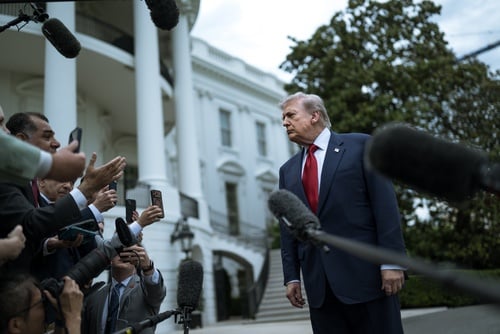
With the recent election’s “blue tsunami” giving Democrats control of both the House and Senate in 2027, many are wondering how much power they will have in a still-divided government.
When reacting to the potential scenario of a Democratic-controlled Congress, Trump told CBS News: “I have the ultimate power – it’s called ‘veto.’”
While presidential veto power is substantial, it is not absolute. Congress can override a presidential veto with a two-thirds vote in each chamber, provided a quorum is present. But that is a high hurdle.
What Is a Presidential Veto?
Article I, Section 7 of the U.S. Constitution grants the president veto power. In a brief civics lesson, this is how a bill becomes a law (cue Schoolhouse Rock!’s “I’m Just a Bill”):
Both chambers, the House and the Senate, must pass the same bill before presenting it to the president. The president can object to the bill with a regular veto, sending it back to the chamber where it originated along with the objections within 10 days. The 10 days do not include Sundays.
If the President does not sign the bill or return it within 10 days, the bill becomes law.
However, a president can reject a bill through a “pocket veto.” This occurs if Congress adjourns before 10 days pass (excluding Sundays). If the President does not sign it while Congress is open, the bill automatically dies. A pocket veto cannot be overridden. Congress would have to introduce and pass the legislation and present it to the president again.
How Can Congress Override a Presidential Veto?
When a bill is vetoed with a regular veto, it goes back to the chamber that originally passed it. The chamber can then vote to override the veto. If successful, the other chamber considers it and holds an override vote. If both chambers vote to override by a two-thirds majority, the veto is overridden, and the bill becomes law without the president’s signature.
If the veto is a pocket veto, the chamber that originated the bill must start the process from the beginning, introducing and voting on the bill again.
Is a Democratic Majority in Congress Enough?
No. The House of Representatives has 435 members. The Senate has 100 members. If all members were present and voting, a two-thirds majority would require 290 votes in the House and 67 votes in the Senate. If fewer members vote, the required number can be lower. An override requires two-thirds of those voting in each chamber, provided a quorum is present.
As of November 5, 2026, it is projected there will be 250 Democrats in the House and 54 Democrats in the Senate. Two races, Mississippi and Alaska, have yet to be called. Even if those turned blue, Democrats would likely need Republican support to override a Trump veto.
Those are two significant challenges. First, all Democrats would have to agree to override a vetoed bill. Then, some Republican Senators would have to make up the difference for a two-thirds majority. A simple majority of Democratic lawmakers does not equal a two-thirds majority.
Has Congress Overridden Presidential Vetoes Before?
Yes. In fact, Congress overrode President Donald Trump’s veto of the 2021 National Defense Authorization Act, which authorized funding levels and set policies for U.S. Defense programs. At the time, Democrats controlled the House, and Republicans controlled the Senate.
Congress also overrode President Ronald Reagan’s veto of the Comprehensive Anti-Apartheid Act of 1986, imposing economic sanctions on South Africa over its system of racial segregation. In 2016, President Barack Obama vetoed the Justice Against Sponsors of Terrorism Act (JASTA) bill allowing victims of terrorist attacks on U.S. soil to sue foreign governments, but Congress overrode it.
While Congress can override a presidential veto, it rarely does. The two-thirds majority requirement is difficult to meet without broad bipartisan support.
Is Trump Going to Block Democrats On Every Law?
It remains to be seen. While Trump holds the veto power, he may use it as leverage to make deals with Democrats rather than reject all legislation. In his remarks to CBS, he said: "Historically, you veto for a couple of months, and then they come and say, 'We've got to make a deal.’”
Trump has previously used executive orders to avoid working with Congress — even when he had a Republican majority in the House and Senate.
The bottom line: A president can reject legislation, but Congress can override that objection with a two-thirds vote in each chamber. However, just because one party controls Congress doesn't necessarily mean it has enough votes to override a veto.