
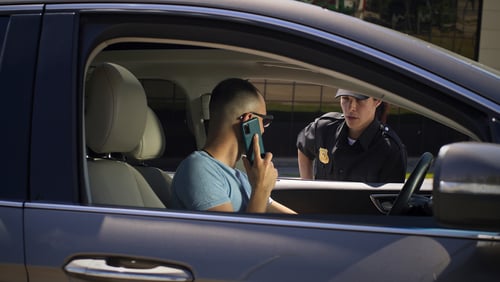
When pulled over for a traffic stop, you know the officer is going to ask for your license, registration, and proof of insurance. Those are items you’re generally required to provide, regardless of how much of the window you decide to open. What if the police ask you to unlock your phone and hand it over? Are you required to do so? Should you?
A roadside encounter doesn’t allow law enforcement to bypass the requirement for a search warrant. Your rights are protected by the Fourth Amendment to the U.S. Constitution. While police can ask that you unlock your smartphone or other electronic devices and hand them over, you are under no obligation to do so unless they have a warrant or there is a specific, recognized exception to the warrant requirement. Phone searches carry a higher bar than the reasonable suspicion that was likely the basis for your being pulled over in the first place. A phone search is a separate legal issue from a traffic stop.
Regardless of how the police may phrase their request for you to unlock your cellphone, sitting in a car doesn’t eliminate your Fourth Amendment rights against illegal searches or your Fifth Amendment protections against self-incrimination. If you find yourself in this situation, you can politely refuse consent to a search of your phone.
If You’ve Got Nothing To Hide, Why Not Let Us Look?
The Fourth Amendment was written to protect Americans from unreasonable searches and seizures and provide them with a reasonable expectation of privacy when encountering law enforcement, depending on the situation. In general, most warrantless searches aren’t permitted, and a court may rule any evidence gathered during one inadmissible.
As technology continues its inexorable march, the law evolves as well. In Riley v. California (2014), the U.S. Supreme Court held that police must get a warrant before searching a phone seized incident to an arrest. Aside from using probable cause to obtain a legal warrant to unlock a phone, the other acceptable means of gaining access to someone’s electronic devices are limited. Some exceptions include:
- If the incident takes place at a border checkpoint (in some situations and jurisdictions)
- If there are valid probation or parole conditions you are subject to that allow a search
- If there are exigent circumstances with either “imminent danger” to public safety or the threat of “evidence destruction,” both of which are held to a high level of scrutiny by the courts; or
- If you consent to a search
Whether you think your phone’s contents are harmless or not, criminal defense lawyers typically recommend that you not give consent for the police (or anyone else) to invade your digital privacy. Certain basic information, like a phone’s subscriber information, might be obtainable with just a subpoena, but any search of the contents will likely require a search warrant. If law enforcement does get a search warrant for your phone, it will likely be for a narrow scope, such as specific apps, text messages, or location data. Giving them consent to search your phone can allow for a broader search.
Importantly, however, the “plain view” doctrine at traffic stops means that law enforcement may be able to search your vehicle if something “immediately apparent” creates probable cause of a crime. For example, if a text message pops up on your phone’s screen and clearly appears to relate to a crime, the officer may be able to consider it when deciding whether there is probable cause to search your vehicle or take other steps. But simply seeing a notification does not give police automatic permission to unlock your phone, scroll through your messages, or search its contents.
What If Police Officers Insist?
Refusing to give consent doesn’t have to be done in an adversarial manner. No need to yell, share your “real opinion” about law enforcement, or curse the officer out. It's always an option to say, in a calm, polite tone, “I don’t consent to a search of my phone.” You also have the right to ask if you’re free to leave.
If the police attempt to take the phone by force, don’t resist. Even still, don’t assume you have to provide the passcode. The Fifth Amendment issues around compelled passcodes can vary by the facts and jurisdiction. At this point, it’s better handled by a criminal defense attorney in a courtroom. Even if you’re subsequently arrested, the police still need to obtain a search warrant to access your phone.
Try to avoid getting drawn into an argument, losing your temper, or doing anything rash. Let the Fourth and Fifth Amendments protect you in the way they are intended to — in court.


