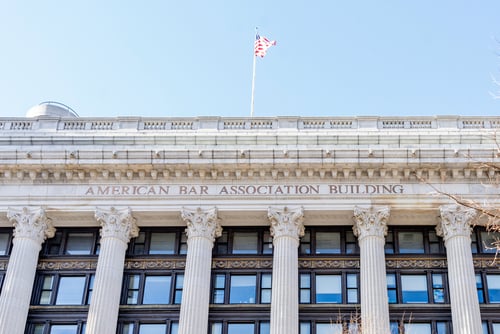
Big things are happening in legal education. On September 8 of this year, the American Bar Association’s independent Law School Accreditation Counsel held a special session, and the ABA Section of Legal Education and Admissions to the Bar repealed Standard 206.
In a 10-6 vote, they ended a diversity and inclusion standard that law schools had previously been required to meet. The repeal looks like an attempt by the American Bar Association to try to remain the nationally recognized law school accreditor in the United States.
The ABA Faced Losing Its Longstanding Status As The Official Law School Accreditor
This move was an important one for the ABA because of a recent action by the U.S. Department of Education. Earlier this year, the Department of Education sent letters to other accreditors, telling them that they would be required to repeal — not just suspend — DEI-related standards if they wanted to remain recognized by the Department of Education.
At the end of August, the Department of Education then recommended stripping the ABA of its longstanding status as the federally recognized accreditor of law schools in our country. The matter is scheduled to go before the National Advisory Committee on Institutional Quality and Integrity on September 23 and 24.
The ABA’s Been the Official Accreditor Since 1952, But the Trump Administration Calls it “Snooty”
The ABA has been the official overseer of United States law schools since 1952, but has clashed with the Trump administration over its DEI standards. Reuters reported that Trump administration officials called the ABA a “snooty” organization of “leftist lawyers.”
The conflict isn’t just limited to the federal government. The ABA has clashed with some states, too, and faces a growing trend in the United States. States including Florida and Texas have ended exclusive ABA accreditation for law schools.
Melissa Hart, chair of the Accreditation Counsel and a retired Colorado Supreme Court justice, said that “[r]epealing Standard 206 was necessary to preserve recognition by a growing number of state courts as well as the department.”
What Was the Diversity Standard?
Standard 206 — the provision that the Accreditation Counsel scrapped — was originally called “Diversity and Inclusion.” It required a law school to demonstrate its commitment to diversity and inclusion among students, faculty, and staff “by concrete action.” The standard specifically addressed opportunities for historically underrepresented groups, including racial and ethnic minorities, women and people identifying as LGBTQ+. To be accredited by the ABA, a law school had to meet Standard 206.
The diversity standard had actually already been suspended in 2024, and that suspension continued through August 2026 because of rapidly changing federal law and policy. When executive orders threatened schools’ federal funding if they supported DEI initiatives, the Accreditation Counsel determined that requiring a commitment to DEI would pose an extreme hardship for multiple law schools.
During this suspension period, the Accreditation Counsel didn’t evaluate schools for compliance with Standard 206. It also didn’t offer guidance on how schools could comply with the standard while it was suspended.
The ABA Says That Enhancing Diversity Is Still Important
Law school accreditation counsel operates independently of the ABA, and neither has direct authority over the other. While the Accreditation Counsel removed the diversity standard, the ABA issued a statement to remind everyone that “the ABA at large has been unwavering and vocal in its continuing commitment to eliminating bias and enhancing diversity within the profession and justice system.” Like many organizations, it faces a conflict between the causes it has historically supported and pressure from the federal government to change.
Who Gets to Accredit U.S. Law Schools Anyway?
Will the ABA get to maintain its status as the official accreditor of law schools in the United States? Will eliminating diversity, equity, and inclusion from its accreditation standards make a difference? When the matter goes before the National Advisory Committee on Institutional Quality and Integrity on September 23 and 24, a big shakeup is possible.
It’s unclear whether the policy change will help the ABA preserve its ability to accredit law schools. Politico reported that Education Department staff suggested denying the ABA’s next renewal bid because of alleged conflicts of interest, which means eliminating Standard 206 might not save the ABA.
Losing Federal Recognition Could Have Broad Consequences
If the ABA ceases to be the official law school accreditor, it could have broad consequences — not just for law students, but for graduates and lawyers — affecting federal student aid, bar eligibility, and the job market. Right now, ABA accreditation is deeply embedded in the legal profession. Graduating from an ABA-accredited law school is generally the most respected pathway to become eligible for the bar in many places across the country. Losing status as the nation's federally recognized law-school accreditor could change everything. Only time will tell.