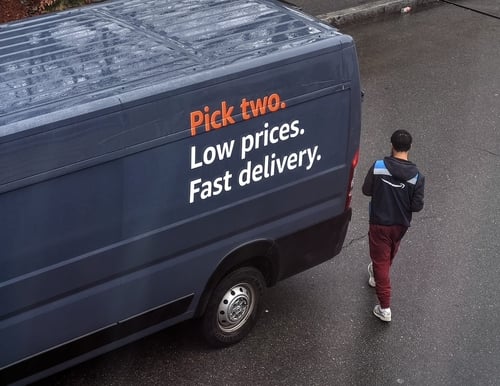
An Amazon driver snapping a photo of your delivered package is one thing. Thousands of images from your neighborhood during a driver’s shift are another.
Public places are full of cameras. But your home isn’t necessarily free from observation, either. Not even from wearable technology.
Amazon has already begun testing smart glasses that help delivery drivers navigate to customers’ doors, scan packages, and take proof-of-delivery photos. While Amazon already photographs packages to capture proof of delivery, these glasses reportedly go further: They take frequent photos while drivers are on foot, potentially capturing people and private property along the way.
Amazon says it is deploying an estimated 5,000 devices this year and plans to have more than 20,000 in the field by the end of 2027. According to Moneywise, a typical shift could produce several thousand images. Those images will be used with Wellspring, Amazon’s generative-AI mapping platform, and may be reviewed by people.
According to that reporting, customers currently have no way to opt out of the image collection, view the collected images, or request their deletion. When asked about a customer opt-out, Amazon executive Viraj Chatterjee told Bloomberg opinion columnist Dave Lee, “We haven’t thought about that.”
Chatterjee also said that “the intent has never been stuff like surveillance.” Amazon says the technology is intended to improve deliveries and includes privacy safeguards, such as automatic blurring, strict access controls, and a hardware privacy switch.
Amazon’s Ring subsidiary settled with the Federal Trade Commission in 2023 over allegations that it allowed employees and contractors to access customers’ private videos and failed to implement security safeguards, enabling hackers to access customers’ accounts, cameras, and videos. In-van camera footage of Amazon drivers has already leaked on Reddit.
Amazon lets customers opt out of its ordinary Photo on Delivery service, according to its customer service page. But there doesn’t appear to be a comparable opt-out from their broader image collection. Amazon’s reported lack of a customer opt-out is separate from a driver-operated privacy switch, which they are supposed to use for things like bathroom breaks.
What If I Don’t Want Companies Taking Photos of My Backyard?
Your backyard isn’t automatically off-limits to photography simply because you own it. Privacy claims generally depend on what was recorded, how it was recorded, and whether you had a reasonable expectation of privacy.
One possible legal claim is called “intrusion upon seclusion.” You may be able to file a lawsuit if someone intentionally intrudes into your private life in a way the law considers highly offensive. Electronic surveillance can qualify, and the intrusion itself can be actionable even if the images are never published online. Requirements vary by state, though, and the “highly offensive to a reasonable person” standard means not all photos will qualify.
What Can Amazon Customers Do?
One practical alternative is to use an Amazon Locker or another pickup location instead of home delivery. That keeps the delivery associated with that order away from your door, though it doesn't stop images drivers capture while passing through your neighborhood.
For home deliveries, consider specifying a drop-off point that isn’t in a secluded part of your property. While that may limit where a driver needs to go, it doesn't guarantee the glasses will stop taking photos.
If you believe a driver entered an area without permission or deliberately photographed a private space, document what happened and raise the issue with Amazon. For a serious intrusion, an attorney can help determine whether the facts support a privacy or trespass claim under your state’s law. Key details include where the driver went, what the camera captured, and what permission you gave them.
For now, Amazon says the glasses are about better deliveries, not surveillance. But that assurance does not answer the question customers may care about most: What control do I have over the pictures a company takes at my home?
The answer may be: not much.