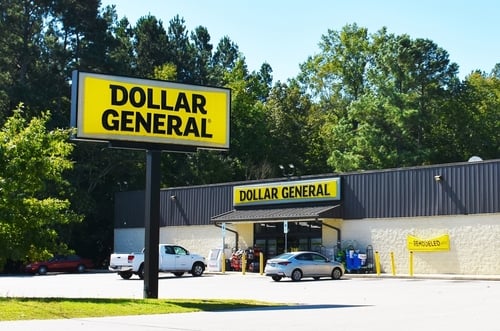
Dollar General Corporation has such broad reach that it estimates 75 percent of Americans live within five miles of one. But for years, customers have complained of overcharging. Namely, prices changing at the register. A bipartisan group of 20 states, from Florida to California, has now joined the Federal Trade Commission in a lawsuit against Dollar General.
The complaint alleges violations of every plaintiff state’s consumer protection laws, as well as federal trade laws. Dollar General has defended itself in a statement, claiming it was blindsided by the FTC while attempting to cooperate on a settlement. However, as Courthouse News reports, this is not nearly the first time the Dollar General Corporation has faced legal action over pricing discrepancies.
The Federal Complaint
The FTC and participating states filed the lawsuit in the U.S. District Court for the Middle District of Tennessee on October 26. The public copy of the complaint provides a background and a sample of consumers’ complaints against Dollar General (although some evidence and allegations are redacted under seal).
Price Changing Allegations: The FTC Investigates
In the last three years, consumers have submitted over 29,000 complaints claiming that Dollar General stores “did not honor marked price[s],” according to the plaintiffs. Shoppers from 48 states have said that Dollar General’s price stickers, signage, internet advertisements, or weekly flyers offered deals which were not honored at checkout.
According to the plaintiffs, one California woman used online info to calculate that her total would be $37.61, only to be charged $50.72. After a store denied printed prices, a Pennsylvania shopper said: “This has happened numerous times on many different occasions. I am tired of being ripped off … I’m also tired of having to take time out of my evening to go over my receipts and then spending the gas money to go over and get my money back.”
In early 2026, the FTC sent undercover shoppers to stores in four states. They reported that “every single undercover purchase resulted in Dollar General charging more at the register than the price advertised for multiple products.” Although some price discrepancies resulted in lower prices rather than higher ones, each investigator’s total purchase still ended in an overcharge in Dollar General’s favor.
The complaint suggests that understaffing is a key factor in the pricing discrepancies. In a December 2025 article in the Guardian, employees themselves point this out. Store policy requires them to manually switch out the store’s newly issued price stickers every week. However, staffers report that “often there are only one or two people on duty” to ring up customers, manage stock, clean up, and otherwise run the store. Whether the stickers change or not, the price changes appear at the register.
Violations of Law and the Plaintiffs’ Requests
As the complaint notes, every state has a consumer protection law against advertising false prices. The states participating in this lawsuit each bring separate counts against Dollar General for violations of their own laws. For example, California claims that Dollar General violated its Business and Professions Code § 17500 “by making or disseminating … false or misleading statements with the intent to induce members of the public to purchase products in retail stores when Defendant knew, or by the exercise of reasonable care should have known, that the statements were false or misleading.”
In all, the states bring 27 counts of violations of consumer protection laws. The FTC brings two counts of violations of federal trade law. It alleges that Dollar General’s pricing amounted to “deceptive acts and practices,” as well as false representations to obtain data from a financial institution — the credit/debit card information of overcharged customers — under the Gramm-Leach-Bliley Act (GLB Act).
The FTC and the states ask the court to issue a permanent injunction against Dollar General, forbidding it from violating any of the named laws. It also requests “monetary relief … civil fines, restitution, disgorgement, forfeitures, or penalties for each violation,” as well as fees and costs. Although the complaint does not name a figure, Dollar General has already rejected the FTC's previous monetary demand.
Dollar General’s Response to Legal Action
The Dollar General Corporation has not yet filed a formal response in court, but it issued a detailed statement on the same day. Dollar General claims that before the filing, the FTC sent it a “draft order of settlement” that “demanded a monetary amount that was untethered to—and orders of magnitude larger than—any realistic assessment of amounts attributable to pricing discrepancies.” Until then, the company says, it had received “no settlement demand or investigative findings … and no settlement discussions had taken place.”
Dollar General says that it “worked tirelessly and in good faith to resolve this matter without litigation,” but that it “will defend [itself] vigorously.” It challenges the FTC’s claim that it sought customers’ financial data under false representations, as well as the government’s basis for “calculating potential settlement ranges.”
Could This Change Things for Dollar General Shoppers?
Lawsuits have already tried to do so, with limited results. Dollar General’s pricing practices have led to no less than eight class-action lawsuits since 2022, according to the complaint; one was settled this past March. The corporation has also settled consumer actions with several states since 2019, resulting in various payouts. In Colorado and Pennsylvania, the settlements require Dollar General to accept its lowest prices. Even so, some states that had settled with Dollar General have joined the current lawsuit.
Dollar General’s pricing discrepancies, whether a few cents or several dollars, can add up to an unexpected grocery bill that weighs heavily on a tight budget. This lawsuit comes at a time when affordability and accountability are on Americans’ minds more than ever.