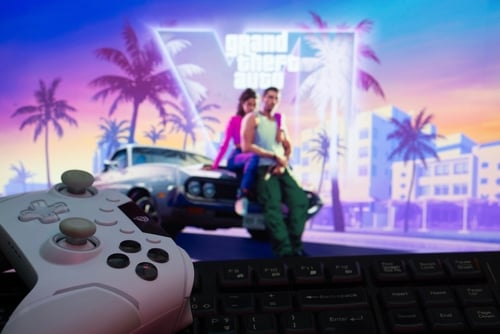
The highly anticipated release of Rockstar Games’ Grand Theft Auto VI (GTA VI) has millions of gamers embroiled in pretend criminal activity as either Jason or Lucia, listening to songs by Yung Lean, Travis Scott, and Dua Lipa as they drive through Vice City. While the music tracks are legitimate tunes by the artists, why is your virtual persona driving a stolen car that looks an awful lot like a Chevrolet Corvette but is called a Coquette D10?
The easy and obvious answer is “money,” and that’s certainly part of it. Given that GTA 6 is a game about living as a modern-day Bonnie and Clyde and committing a large number of criminal acts, that isn’t a lifestyle some companies want associated with their brand. While songs about living a life of crime may be a perfect fit for the GTA universe, using an XC90 to deliberately run people over probably isn’t the image family-minded Volvo wants associated with it. So while real music is an integral part of the GTA world, real brands are swapped out for lookalikes with fake names.
Getting licensing and approval to use actual brands also tends to require more ongoing attention than acquiring licensed music rights, with game developers often hampered by design restrictions and the need for ongoing collaboration. With almost 300 vehicles available in GTA 6, making them all actual licensed cars would have been prohibitively expensive. Outrunning corrupt police in Vice Beach with the music blaring can be fun, but you’ll have to do so in a parody brand Pfister Comet S2 instead of the Porsche 911 Turbo S Cabriolet it strongly resembles.
You Can Steal the Car, but License the Music
It’s been over 13 years since Rockstar Games, a label under Take-Two Interactive, released the massively popular Grand Theft Auto V (GTA 5). To say GTA VI has been eagerly awaited would be an understatement, as pre-orders topped $1.5 billion. GTA VI lets gamers roam Leonida (totally not Florida, nope, not at all), look for the Skunk Ape, spend as much time as possible with Goth girl Vicki, and pull heists.
To help make the immersion as complete as possible, GTA VI includes a soundtrack with over 50 songs. Whether the music was composed for GTA VI or already existed, licensing a song means clearing the necessary music rights. Under copyright law, the game company must secure both the master rights (the recording) and the sync rights (pairing the music with the visual gameplay). This involves reaching agreements with all co-owners of the music, which may include the publishing company and all writers/composers. A pre-cleared license from a library or the composer may also suffice. In general, the rightsholder(s) receive a single payment for permission to use the piece of music.
Things get more complicated when the inclusion is an established brand. Being the official baseball bat of Vice City might appeal to Louisville Slugger, but the company may be less enthusiastic after discovering that its branded product is mainly used to smash windows during looting or to administer a beatdown. Unlike a song, using an item’s intellectual property can come with other demands.
While racing video games are enticing as product placement for manufacturers that make F1 vehicles, GTA is a different experience. Maybe Ford is okay with a Mustang being a GTA VI vehicle, but it’s going to insist the vehicle is accurately depicted, a level of scrutiny that will cost time and money to satisfy. Would Coke be pleased if they licensed their product, only to have the cans not look quite right? Smith & Wesson may be well-known for producing firearms, but that doesn’t mean that they want to be associated as the weapon of choice for criminals in a violent video game. Hence, fake cars and fictional brands.
You’ll Have This Grouse (Which Is Totally Not a Buick Skylark) and Like It
Skipping a license and using real vehicles anyway can also lead to a lawsuit. Activision put Humvees in its “Call of Duty” games without a license from the manufacturer, AM General. AM General sued over the use of its trademarks. Activision was granted summary judgment in 2020 after a judge, applying the Rogers test, found that the Humvees added realism and did not explicitly mislead players about AM General’s involvement with the games.
So if Activision could get away with including Humvees in its game without paying, why can't Rockstar Games? Well, it might be able to, at least when it comes to a car sitting in a game. But "winning" isn't the same as "winning cheaply." Activision's victory came in 2020, only after years of litigation, and every game with real brands invites a lawsuit. A court can also decide differently, depending on how a brand is used. Add the fact that a company can still sue even when it's likely to lose, and fake names start to look like the cheaper, safer path.
While GTA VI wants to present a world that’s as close to reality as possible, paying licensing fees for every car, drink, or weapon would be both time-consuming and prohibitively expensive. Including some real brands might be doable, but it is legally risky. So instead of doing a shot of Jack Daniels before grabbing your Desert Eagle .50 caliber and jumping into your ‘69 Camaro, you’ll have to settle for swigging some MacBeth Whiskey, holstering your Deadringer 1922, and hopping into your Creado instead. Maybe you’ll be fortunate enough to find yourself a fighter jet or a secret hidden tank during your adventures.