
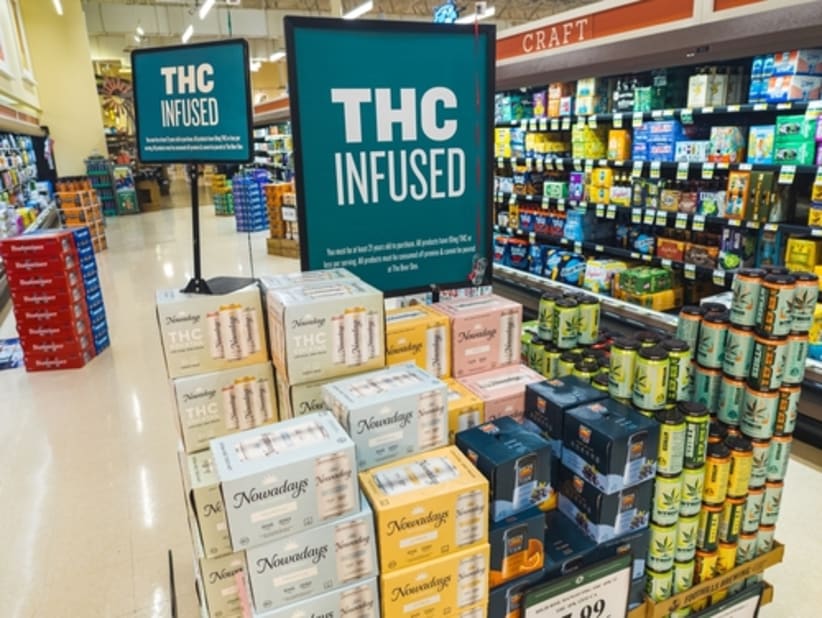
The racks and reach-in coolers at your local liquor stores, markets, and gas-station convenience stores may have a few open spaces available for new products in a couple of months. That is, unless Congress decides to amend what it just amended last year.
As part of an agricultural spending package that was part of the agreement that ended the federal government shutdown in 2025, Public Law 119-37 closed the infamous “Hemp Loophole” created by the 2018 Farm Bill’s passage. It’s scheduled to take effect in November 2026, placing hemp-derived cannabinoid products back under the same classification as cannabis. Hemp-derived THC products containing Delta-8 THC and Delta-9 THC had ushered in an explosion of growth for the hemp industry.
That’s all set to change on November 12 of this year, as the amended federal definition of hemp will treat any finished hemp‑derived cannabinoid product with more than 0.4 mg total THC per container as “marijuana” under the Controlled Substances Act, rather than “hemp.” If it goes into effect unaltered, the amendment will eliminate the ability to ship qualifying hemp-derived THC beverages, edible gummies, and other intoxicating hemp products across state lines and, depending on state law, may limit sales to dispensaries with other cannabis products.
For consumers who’ve gotten used to grabbing a THC seltzer at the liquor store or corner market, the practical effect could be that those drinks suddenly become much harder to find. This is particularly true in states like Minnesota that have very few licensed cannabis dispensaries.
The recent rescheduling of cannabis by the Drug Enforcement Administration from Schedule I to Schedule III under the Controlled Substances Act is no consolation for the industry, as the new classification only applies to medical marijuana possession and use. The looming ban may not only affect those who enjoy kicking back with a THC seltzer, as the expected decline in demand could prove to be a serious buzzkill for hemp drink and edible manufacturers, as well as industrial hemp farmers.
Okay, but Where Is Cranberry Coconut Green Refresh Going To Be Available?
In the 2018 Farm Bill, the House Agriculture Committee made one small but important tweak that turbocharged the hemp industry. Hemp products with under 0.3% THC were no longer defined as cannabis under the CSA, giving rise to a marijuana and alcohol alternative that wasn’t subject to seizure by agencies like the Drug Enforcement Administration (DEA) for traveling over state lines.
While it may not have been under the same level of scrutiny as cannabis, hemp products had regulations and standards of their own to meet. Hemp is third-party lab-tested and must receive a Certificate of Analysis (COA) that verifies legal THC levels, potency, and safety standards. The products are also subject to state laws, some of which were specifically created to address the emergence and ensuing popularity of intoxicating hemp beverages, infused tea bags (!), and edibles.
It may soon be moot, but 13 states have outlawed products containing Delta-8 THC and another seven have regulations or restrictions in place, despite many of these jurisdictions allowing medical and/or recreational cannabis use. Some expressed concern that the brightly-colored packaging and sweet flavors were targeted at a younger audience. As most hemp THC beverages have between 5mg and 10mg per container, the days of being considered different than cannabis products are dwindling.
Well, There’s Always Clothing, Twine, and Hemp Bricks
There have been bills introduced to re-amend the incoming hemp definition to mitigate the fallout if it goes into effect, but none have found traction yet. According to the U.S. Hemp Roundtable, the hemp industry has generated $28.4 billion in revenue and is responsible for over 325,000 jobs nationwide. The restrictions that would come from once again being defined as cannabis may prove crushing to manufacturers who could no longer ship products to different states and would have to fight for precious shelf space in dispensaries.
Hemp farmers may also be looking at a bleak future with the redefinition. Some studies have shown that industrial hemp can be extremely profitable for farmers, even more so than corn and other crops. With a potentially cataclysmic change a few months away, what was once a surging crop may soon be up in smoke.


