
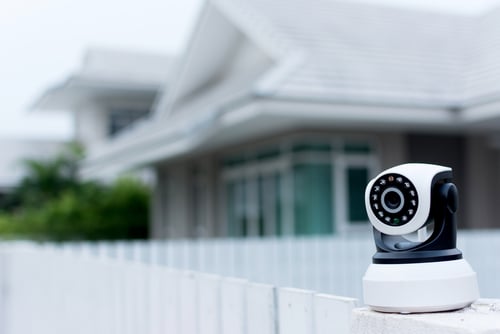
Our lives can often involve a good deal of random chance. This is perhaps never truer than when you move into a dwelling and meet a variable you can't control: your new neighbors. You might hit it off with them and become the best of friends, but there’s also a very real chance the relationship will be rife with issues and headaches. This can include walking outside one day and noticing a newly installed video surveillance camera on your neighbor’s property that’s pointed at your house. Is that a violation of your right to privacy?
As is often the case with sticky legal questions, the details will dictate the answer. In general, any camera pointed where you have a reasonable expectation of privacy creates legal risk. What counts as an invasion of privacy can vary by state, county, and local ordinances and statutes, but home security camera placement that records a location screened from the public’s field of view is likely to be considered an encroachment on your seclusion. Determining what qualifies as a property owner’s private space can lead to neighbor disputes and escalating unpleasantness.
Discovering your neighbor’s outdoor security camera pointing at your backyard can be unsettling, but immediately pursuing legal action might not be the best option. While your privacy concerns are legitimate, you may be able to resolve the issue with a friendly conversation. If the camera is pointed at your bedroom window, that’s an entirely different situation. Understanding your rights and restrictions can help ensure you can relax on your private property.
I Always Feel Like Somebody’s Watching Me
With an ever-increasing chance that someone (or something) is recording you in public areas, your home can feel like a refuge from prying eyes. The advent of affordable digital security systems can put a crimp in that sense of privacy. Your neighbor has the legal prerogative to install cameras to protect their home. Does that take precedence over your privacy rights?
Whether a security camera’s placement is a privacy violation depends on what’s in its field of view. For example, if your front yard is clearly visible from the street, you don’t have an expectation of privacy there. If part of it falls under the scope of your neighbor’s camera, you likely don’t have a legal leg to stand on with a privacy complaint. However, if your neighbors camera is set up to see inside a bedroom or bathroom window, that’s often a different story. Since most of these rooms have either shades or curtains (or both), you have a completely plausible expectation of privacy. Having a surveillance camera fixed on it, particularly if it’s positioned to see inside, violates those expectations.
Things get a little more complicated with backyards. Exact laws vary by jurisdiction. A good barometer for the legality of a camera’s field of view is this: if someone couldn’t see the area without trespassing or using special equipment, it’s likely considered a private space. Fenced backyards, privacy screens, and large patio umbrellas strengthen this by increasing the expectation of privacy. A neighbor may be able to place a camera high enough to see over a privacy fence, but that’s not always a good idea.
All Right, Mr. DeMille, I'm (Not) Ready for My Close-Up
When you first spot a new camera, try not to overreact. First, do your best to confirm that the camera’s field of view includes angles that appear to violate your privacy. If it does, a courtroom shouldn’t be your next step. Instead, try a friendly conversation with your neighbor. They may not realize the camera is encroaching on your private space or that it would be a problem. Something as simple as a chat might solve the issue.
If that doesn’t work, other avenues are still available besides legal options. You can try to block the camera’s view, either by putting up a solid fence or installing landscaping with obscuring plants. Make sure anything you plant is on your side of the property line. This also bolsters your position if litigation becomes necessary, as anything placed to block sightlines to your property increases your expectation of privacy.
Despite your best efforts, you may not be able to reach a solution without involving the courts. To prepare, document the camera’s angle and what it shows. Take pictures of the property line between the two dwellings. If you don’t feel confident with your knowledge of the applicable laws, consider speaking with a local property attorney before filing anything. You could seek an injunction for invasion of privacy and intrusion upon seclusion that legally blocks your neighbor from pointing a camera at a certain part of your home. Some jurisdictions offer formal mediation as a resolution option, which means you and the neighbor will try to reach an equitable agreement with the help of a neutral third party.
In addition to what you may have to do, there are things you should absolutely not do. Don’t threaten your neighbor in any way. As much as the camera may vex you, don’t do anything that could harm it. This includes using spray paint, pointing a laser at it, throwing rocks to knock it down, or trying to hack or jam the system. That may put your dispute before a judge, but for the wrong reasons.


