Middle school civics class may seem like a long time ago. And unless you’re a legal professional, teacher, or avid Jeopardy watcher, you likely don’t often encounter situations that require you to rattle off the three branches of government, the Bill of Rights, or Second Amendment protections.
So, is it really surprising that a chunk of Americans can’t recall basic constitutional principles and our government structure?
The recent University of Pennsylvania Annenberg Constitution Day Civics Survey revealed that only two-thirds of Americans could name all three branches of government. If you’re struggling to name those three branches as you read this, you’re not alone. While this gap in knowledge may seem insignificant, forgetting the basics can affect your rights in real-life situations — big and small.
Why Does Civics Knowledge Even Matter?
“Ignorance is costly. You can’t protect and cherish rights that you don’t know you have,” said director emerita of the Annenberg Public Policy Center Kathleen Hall Jamieson.
And she has a point. If you don’t understand the basics of how government works, you may not recognize when your rights are being infringed on or when officials overstep their authority. Knowing what agencies do, how laws are made, and what the Constitution protects isn’t just useful trivia. It empowers you to push back and advocate better for yourself and your community.
Let’s say you see a social media post about a governor overturning a Supreme Court ruling. If you know how the branches of government actually work, you can spot that the claim is fake news and avoid being misled or spreading misinformation.
Or what if your child’s school district changes a policy without public input? If you know how local government works, you can check whether they followed required procedures, show up at a meeting, or submit a public comment.
And most of us have been pulled over while driving. What if the police officer asks to search your car “just because”? If you know your Constitutional rights, you understand when you can say no and when a search requires consent, a warrant, or probable cause.
So it’s more than just not knowing the three branches of government. Not having a baseline awareness of civics can have serious implications.
Ready for a refresh? Keep reading for a quick civics education crash course.
What Are the Three Branches of Government?
Let’s start with the headline-grabbing statistic regarding the three branches of government.
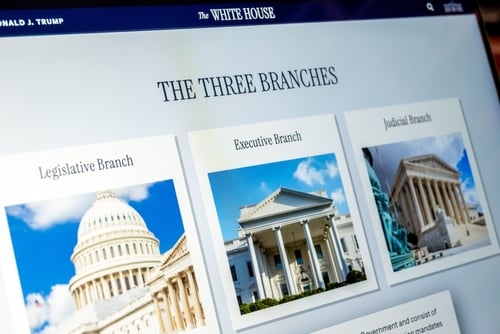
The three branches exist to ensure separation of powers. This checks-and-balances system ensures no single part of government can control everything.
Legislative Branch
- Comprised of Congress, which includes the Senate and the House of Representatives
- Primary role is making the laws
- Key powers include passing bills, declaring war, and approving presidential appointments.
Executive Branch
- Comprised of the President, Vice President, and the Cabinet
- Primary role is enforcing and administering the law
- Key powers include signing or vetoing laws, commanding the armed forces, and negotiating treaties.
Judicial Branch
- Comprised of the Supreme Court and other federal courts
- Primary role is interpreting the laws and the Constitution
- Key powers include evaluating laws and resolving legal disputes to see if they follow the Constitution
What’s the Difference Between an Executive Order, Statute, Court Ruling, and Agency Regulation?
An executive order is a directive from the president or a governor that manages how the executive branch operates but cannot contradict existing statutes.
- Example: President Trump’s declaration of a national emergency to secure the U.S. bulk-power system allowed the executive branch to restrict certain foreign‑supplied electrical equipment deemed a security risk.
A statute is a law formally enacted by the legislative branch.
- Example: The Consolidated Appropriations Act of 2026 resolved massive budget standoffs following the previous year's federal government shutdown.
A court ruling is a decision made by judges that interprets the law and can set binding precedent for future cases.
- Example: The Supreme Court’s decision in Dobbs v. Jackson Women’s Health Organization (2022) overturned Roe v. Wade and changed how states regulate abortion.
An agency regulation is a rule a government agency creates to implement laws Congress passes.
- Example: The Environmental Protection Agency (EPA) is a federal agency in the Executive Branch that Congress has tasked with enforcing numerous environmental regulations. While Congress passes the actual laws, such as the Clean Air Act, it often gives the federal agency authority to create its own regulations and enforcement decisions. This is why the EPA can roll back greenhouse gas emissions limits for fossil-fuel power plants and vehicles.
What Does the 10th Amendment Say About States’ Rights and the Federal Government?
Half of U.S. adults answered this one correctly on the recent civics knowledge survey.
Under the Tenth Amendment, powers not granted to the federal government are reserved to the states or the people. This means states can make their own laws in areas the Constitution doesn’t address. This is why states control things like education, policing, family law, and many regulations that impact everyday life for Americans.
For example, New York’s Click to Cancel rule takes effect in October 2026 and requires companies to make canceling an online subscription as easy as signing up. That law will apply only to New York residents and businesses.
What Protections Are Included Under the First Amendment?
The First Amendment protects five core freedoms:
- Freedom of speech
- Freedom of the press
- Freedom of religion
- Freedom of assembly
- Freedom to petition the government
These First Amendment rights impact many areas of life. They ensure people can gather, criticize the government, and practice their beliefs without government interference. For example, freedom of assembly allows you to gather for meetings, protests, or rallies, protecting peaceful protests in public spaces. Your right to petition the government lets you challenge a denied benefit, a local ordinance, or police misconduct.
Who Are the Current Supreme Court Justices?
Nine justices comprise the U.S. Supreme Court (SCOTUS). These justices serve lifetime appointments and are appointed by the President and confirmed by the Senate. Turnover only happens when a justice retires, passes away, or steps down. Some serve for decades. Currently, the Supreme Court justices are:
- John G. Roberts Jr. (Chief Justice)
- Clarence Thomas
- Samuel A. Alito Jr.
- Sonia Sotomayor
- Elena Kagan
- Neil M. Gorsuch
- Brett M. Kavanaugh
- Amy Coney Barrett
- Ketanji Brown Jackson
For a more comprehensive refresh, try the Pew Research Center’s civics quiz.