
Website Visibility in Google AI Search & Major AI Tools for Legal Services Queries
March 2, 2026
Google's AI-focused features—AI Overviews (AIO) and AI Mode—represent a paradigm shift in how Google's search results pages are displayed. Our testing of Google’s AI surfaces, and review of Google documentation, supports that Google’s underlying AI response ranking mechanisms remain closely aligned with those that power Google’s traditional organic search. Authoritative sites built around Google's Helpful Content framework, sound technical SEO, and robust EEAT (Experience, Expertise, Authority, Trust) signals continue to perform well in both classic results and Google's new AIO/Mode surfaces. As Gary Illyes reiterated at Search Central Live (July 2025), AIO relies on "the same crawler, same index, same ranking systems" that govern standard search.
However, once we move beyond Google’s AI‐enhanced search results, notable differences become apparent, most prominently within OpenAI’s ChatGPT, which holds the largest market share of AI tool usage. In our analysis of legal transactional/commercial queries/prompts, we observed that Perplexity, Gemini, and Claude tend to mirror Google’s first‐page rankings, whereas ChatGPT surfaces a more diverse array of brands and professional sources.. The common factors statistically identified behind nearly every ChatGPT recommendation on millions of legal services queries/prompts, and on a good fraction of responses from Perplexity, Gemini, and Claude, is what we call the 4 R's of AI visibility:
- Ratings – authoritative professional scores on trusted and legal-specific platforms (Google, Avvo, FindLaw, Martindale-Hubbell, etc.).
- Reviews – high-quality client and peer feedback on authoritative and legal-specific platforms (Google, Avvo, FindLaw, Martindale-Hubbell, etc.).
- Recognitions – peer-awarded legal honors and industry accolades (Super Lawyers, Avvo, Martindale-Hubbell, Best Lawyers, etc.).
- Roots – complete, consistent, crawlable authoritative legal website/directory profile data that repeatedly signals an attorney's or firm's identity across the open web.
The four attributes—Ratings, Reviews, Recognitions, and Roots—serve as primary data sources for ChatGPT and, to a lesser extent, for other AI systems such as Perplexity, Gemini, and Claude. When a firm is strong across every one of the four R’s, it can achieve AI visibility despite having only modest organic‐search visibility. On the other hand, firms that typically hold high organic visibility may see weaker placement within AI tools if one or more of the four R’s is underrepresented.
Our evaluation spanning thousands of manual tests and millions of API-generated AI responses to transactional/commercial legal services prompts further revealed insights into several leading AI tools. Perplexity's answers coincided with Google page one results in more than 75% of cases, Claude in roughly 75%, and Gemini in about 50%. ChatGPT, by contrast, matched less than 25%. But when we recalculated alignment on the narrower basis of the 4 R's, ChatGPT's overlap increased. In other words, traditional SEO tactics aimed at Google page one visibility are currently sufficient for visibility on legal transactional/commercial prompts in Perplexity, Gemini, and Claude; succeeding in ChatGPT additionally needs strengthened 4 R signals.
It should be noted, Perplexity and Claude may soon decrease their reliance on Google-derived data—particularly Google Business Profiles—when processing transactional or commercial prompts. The results presented here, however, describe their current behavior. It should also be noted, our analyses focus primarily on transactional and commercial queries, not informational ones. We’ve observed that this key distinction goes unaddressed in most AI-search articles, despite LLMs routinely producing and reporting distinct types of responses for informational versus transactional/commercial prompts. Inclduing preferred data sources. A white paper on legal informational queries/prompts in the major AI tools will be published shortly.
Because each AI platform weighs inputs differently, AI Engine Optimization (AEO/GEO/LLMO) is not a "one-size-fits-all" extension of classic SEO. This white paper unpacks those differences, detailing how the 4 R's shape ChatGPT recommendations while Google's SERPs continue to be a leading data source for other AI tools alongside the 4 R's. Drawing on log-level data, controlled experiments, API audits, and independent replication, we present a snapshot of the fast-moving AI search landscape and provide empirically grounded recommendations for earning visibility today, while staying agile for tomorrow's inevitable shifts.
Google Traditional Organic Search Results vs. AI Overviews vs. AI Mode
Google's Traditional Organic Search Results
Since their 1998 launch, Google's organic results, still the prevailing format, display a vertical list of hyperlinked titles, URLs, and snippets, a retrieval-centric presentation that surfaces existing text rather than generating new content. Rankings hinge on factors like link authority (PageRank), Helpful Content signals, freshness, topical relevance, user engagement, and light personalization driven primarily by location, language, and account history. Users scan snippets, click chosen links, evaluate the content, and, if unsatisfied, adjust the query. Accordingly, site owners monitor metrics such as click-through rate, dwell time, and reduced query reformulation.
AI Overviews (Answer-on-Top)
AI Overviews, also called "Snapshots" or "Summaries," appear at the top of many Google SERPs. A language model distills multiple sources into a concise paragraph or bullet list that often answers the query outright. This brief, scan-friendly text, accompanied by inline or footer citations, pushes ads and traditional results farther down the page. As a result, users typically read the summary first, open cited pages only for additional context, and scroll to organic listings last. Performance is gauged by the zero-click rate, the summary's factual accuracy and resistance to hallucinations, and its downstream impact on organic CTR and ad revenue.
AI Mode (Conversational Search)
Opt-in conversational search, offered as a standalone product, tab, or toggle, turns a query into an ongoing dialogue with an LLM that retains the entire chat history. It provides concise answers, code snippets, outlines, personalized suggestions, and rich media while invoking external tools such as code runners or shopping APIs. Citations appear as inline links or expandable cards. Each session begins with a seed question, expands through iterative follow-ups that branch into related subtasks, and often completes actions, such as purchases or bookings, without returning to traditional SERPs. Performance is measured by per-turn feedback, session duration, and downstream conversions.
Website Visibility in Google AIO/Mode
At Singapore Search Central Live in July 2025, Google Search analyst Gary Illyes stressed that the company's new AI features are "built on the same infrastructure" as traditional web search. He noted that engineers repeatedly wrote "same as above" in internal design documents, underscoring that AI Overviews depend on the identical crawler, index, ranking pipeline, link analysis, and quality signals. Nothing in the core search architecture was developed separately for the AI experience.
Illyes reiterated to publishers that inclusion in AI Overviews still hinges on the fundamentals, like creating high-quality, helpful, and trustworthy content. He emphasized that visibility continues to be driven by the same familiar signals, such as topical relevance, link-based authority, positive user engagement, and sound technical hygiene. His remarks echo guidance already issued by Google's Search Liaison team and detailed on the "AI Overviews and Search" help page, December 2025.
Key points
- There is no dedicated "AIO crawler."
- The Helpful Content and core ranking systems continue to evaluate pages through the lens of E-E-A-T, Experience, Expertise, Authoritativeness, and Trust.
- AI-generated text is acceptable when it delivers genuine value and complies with anti-spam policies.
- The most dependable route to visibility across every Google search feature remains familiar ones, such as clear information architecture, valid structured data, fast page performance, helpful content, and authoritative backlinks.
Google's John Mueller points to Google's checklist, "Top ways to ensure your content performs well in Google's AI experiences on Search", May 2025. In short, the path to Google's AIO/Mode visibility remains unchanged with factors like, publish unique, people-first content, deliver an excellent page experience, grant Googlebot full crawl access, manage visibility with index/noindex tags, ensure structured data accurately mirrors on-page text and fully validates, and enrich your pages with complementary images or video to support multimodal search.
Consequently, assertions that Google's AI search requires an entirely new playbook are currently not supported by Google or the data from studies we have performed or reviewed by others. Google's own engineers and several independent studies, including ours, have detected no meaningful departure between visibility in Google AI Search and the traditional ranking signals that already drive Google's organic performance.
Drawing on our internal research, FindLaw reviewed Google's AIO-generated results across more than 20 industries in August 2024, November 2024, February 2025, September 2025, December 2025, and January 2026. The analyses revealed that websites found in Google's top 30 organic results were the majority of the time (77.3%) surfaced in AIO/Mode as well. They also identified three Helpful Content frameworks that correlate with stronger performance in Google's organic results, featured snippets, and AIO/Mode citations, confirming Google's public message that both experiences use the "same crawler, same index, same ranking" system. Producing helpful, well-structured, comprehensive content drove gains across every search surface. In short, authoritative sites that excel in E-E-A-T and attract strong on-page user engagement signal trustworthiness to Google, which then features their content in both organic listings and AIO/Mode responses.
Direct Definition Framework
Although our FindLaw Helpful Content frameworks remain proprietary, our Direct Definition framework mirrors the often-cited definition lead of journalistic practice. The approach requires stating the page topic immediately at the top of the main content, giving users a direct answer to their query without unnecessary narrative or "needle-in-a-haystack" searching. Comprehensive, detailed coverage should then follow. For example, if a consumer searches "what is slander?" and lands on a page titled "Slander," the content should open with a statement such as, "Slander is a false verbal statement…," rather than with, "Isn't it terrible when someone says something bad about you and worse, it's not true?" Scenic narratives like the latter are not well supported for discovery and visibility in both Google's traditional organic results and AIO/Mode.
In an initial study of 35 content pages, we revised the on-page material to elevate their scores across all three Helpful Content frameworks from low to high. Comparing the four months after optimization with the four months before, Google search clicks increased by 54.3% and impressions by 36.3%. The study period took place a year after the AIO launch in May 2024. The pages also improved their performance in both traditional organic results and AIO/Mode responses.
Our research, studies, and testing of our Helpful Content frameworks indicate that performance in all Google results, including AIO/Mode, is still driven by creating people-first, helpful content, fully aligned with Google's guidance for ranking in organic and AI responses. Google's guidance for AI search visibility reinforces longstanding SEO and content fundamentals, the same key best practices that have steered technical SEO and content strategy for years. In essence, Google has introduced no esoteric, AI-specific ranking signals. It has simply layered a generative summary atop the same index and quality metrics it has been refining for nearly three decades.
Website Visibility in AI Tools: ChatGPT, Perplexity, Claude, and Gemini
Although definitions of AEO, GEO, and LLMO vary across sources, the three concepts share broad parallels. Answer Engine Optimization (AEO) focuses on structuring content for rapid extraction in direct-answer surfaces such as voice assistants and featured snippets. Generative Engine Optimization (GEO) centers on positioning pages to be selected, summarized, or cited by generative search layers. Large Language Model Optimization (LLMO) seeks to ensure accurate, prominent representation within standalone LLM responses such as ChatGPT.
Although the goals of AEO, GEO, and LLMO are relatively straightforward, guidance on how to achieve them typically varies across sources, yet nearly all of these sources still cite a large proportion of recommendations that are often found to simply be traditional SEO and content best practices. Where the recommendations do stand out with new, and exclusively, AI optimizations, these are typically not presented with supporting data, leaving several open questions around what AEO/GEO/LLMO are exactly.
For instance, a common assertion holds that AI bots look for dedicated AI schema during crawling. Yet two recent experiments reported by Barry Schwartz dispute the notion that such structured data enhances visibility in AI search.
- In the first study, researchers observed that when LLMs crawl a page, schema markup is frequently stripped out during ingestion, eliminating any potential benefit, let alone any edge from a theoretical AI-specific schema.
- In the second experiment, the researchers built two otherwise identical product pages. One included human-readable text plus schema, while the other contained only schema markup. After querying Gemini and ChatGPT hundreds of times for details such as price, color, and SKU, the models consistently returned accurate answers only from the page with visible text, indicating that AI bots disregard information supplied solely through structured markup.
Despite these findings, some vendors continue to market "AI schema" solutions that claim to "AI-proof" your SEO. One advertisement shown below promotes schema markup tailored for AI, yet clicking through reveals no such code or best practice, only a product page for a tool that tracks visibility in AI models.
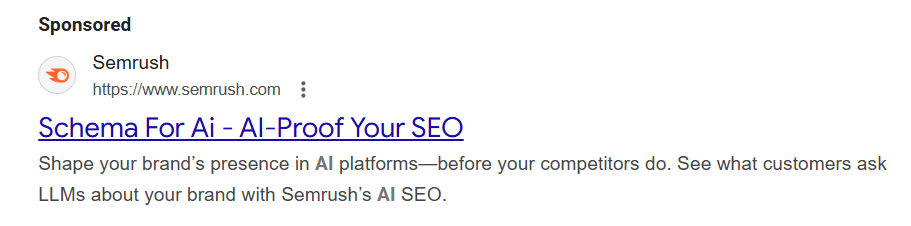
Regardless of clear evidence for AI specific schema, implementing traditional schema supported by search engines like Google and Bing is highly recommended for organic and AI search visibility with direct and indirect effects across these channels.
Another common AI optimization we found among AEO/GEO/LLMO articles is the implementation of LLMS.txt files. As Patel (2025) writes, “As AI-generated search becomes more prominent, the importance of LLMs.txt grows. You can adjust your directives over time, but having the file in place keeps you in control of how your content is used today.” To test this premise, we deployed LLMs.txt files on all of our principal legal portals and analysed server logs for more than 90 days. During this interval, no AI crawler accessed the LLMs.txt files, whereas the same sites registered several million requests for standard content pages.
Understanding AI visibility and potential optimizations toward improving such visibility is in its infancy. It should be noted that AEO, GEO, and LLMO are terms not found in Google's documentation, patents, or APIs, but have been coined by the SEO/DM industry. As a result, the AEO/GEO/LLMO arena is still being defined and has yet to come to a full consensus set of recommendations within the SEO/DM industry, unlike the broad alignment usually found in established SEO and content best practices. There are, however, several emerging studies into AI tools.
A study of 3,000 websites found that 63% logged at least one visit attributed to an AI chatbot, yet those visits averaged only 0.17% of total traffic, below the share generated by email. Although some AI clicks may be misclassified as "direct," our internal log-level data across tens of thousands of URLs reveal similar proportions, corroborating the study's findings. Furthermore, three chatbots produced 98% of all AI referrals, with ChatGPT alone responsible for more than half.
The data yield two important findings:
- AI-originated sessions remain statistically low, limiting the ability to run meaningful experiments on search traffic aimed at AI-specific optimizations.
- If AEO/GEO/LLMO tactics show precise gains in AI visibility, the resulting traffic uplift would presently be negligible relative to their cost.
Although ChatGPT is nearing a billion weekly users, the ceiling on potential website visits from the tool remains statistically low. Even at fuller user saturation across AI surfaces, AI referrals, for the websites studied, are not on pace to exceed 5% of total website traffic.
Corroborating these findings, another AI-Impact study noted that citations within AI tools generate little direct traffic. Instead, "the main benefits are increased brand awareness and positive brand sentiment through on-platform mentions." We concur and have determined internally that "winning" in AI tools means being part of the answer or response. Mentions in AI tools such as ChatGPT, Perplexity, Gemini, or Claude are perceived to have a greater brand impact than mentions within other portals like social media; while this is a qualitative observation from our current studies, it remains an alternative hypothesis we will quantitatively test in the coming quarter.
We conducted a study of more than 300 legal-service queries in Google Search to capture data on AIO, local, sponsored, and organic results, as well as on responses from ChatGPT, Perplexity, Claude, and Gemini. All queries were executed through a VPN with no personalization and varied geolocations. Examples included "top chicago divorce lawyers", "los angeles car accident attorney", and "help me find a personal injury law firm near me." Google AIO triggered for only roughly 20% of these searches. In other words, about 80% of the time, AIO was absent and Google only presented its traditional SERPs. It is noted that we see this reverse trend of 80%/20% AIO initiated on SERPs for informational legal queries/prompts, which will be addressed in our white paper on informational legal searches in Google and AI tools.
ChatGPT returned an average of about 7.8 recommendations, attorneys, law firms, legal directories, etc., whereas Perplexity produced about 12.3 recommendations, nearly twice as many visibility opportunities for legal entities. Considering ChatGPT's larger user base, its narrower recommendation window still offers meaningful exposure for businesses seeking AI-tool visibility.
As previously noted, Perplexity's recommendations overlapped with Google page-one results in more than 75% of cases, for example, there were instances where all attorneys / law firms it suggested also appeared prominently on Google's page one for the same query, and often these firms were found multiple times across AIO, when it kicked off, local, and organic listings. Claude showed a very similar trend and behavior to Perplexity in matching about 75% to Google's page one, while Gemini matched about 50%. ChatGPT showed a lower yet notable overlap of a little less than 25%.
This resets the mindset around AEO/GEO/LLMO - instead of assuming that any specific optimization exists universally for all LLMs (i.e. LLMS.txt, FAQ section, etc.), it first must be determined if they do and then, to what extent for each AI tool.
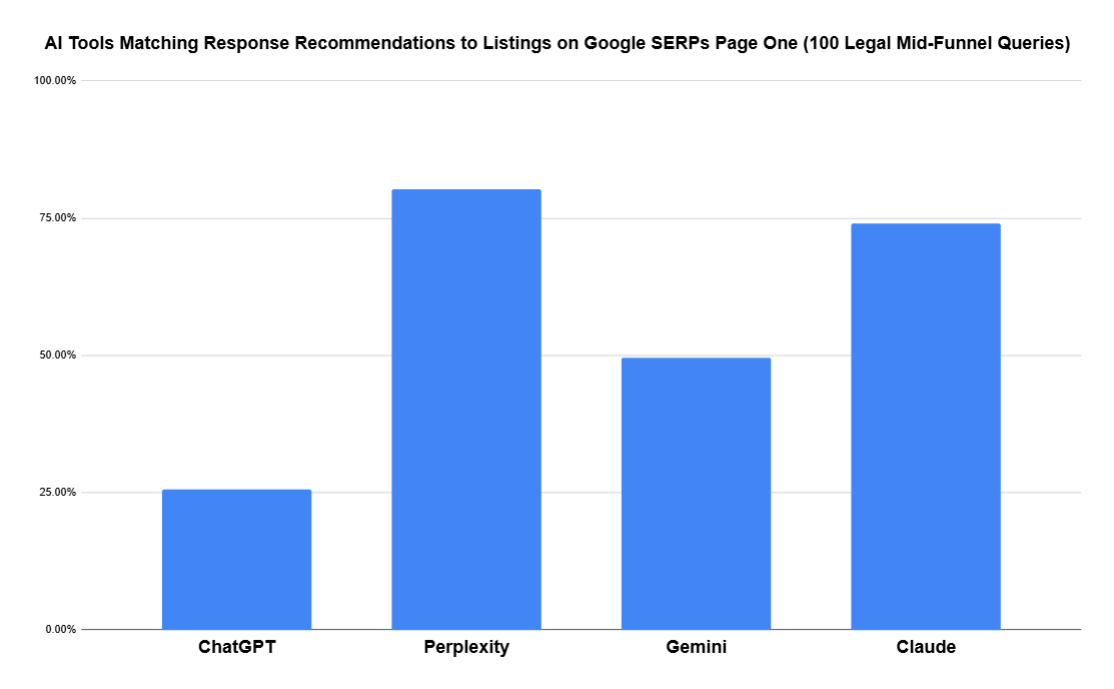
Analyzing millions of legal transactional/commercial queries/prompts via the OpenAI API on ChatGPT models produced the following results.
- The four most frequently cited legal directories were Super Lawyers, Avvo, Martindale-Hubbell, and FindLaw.
- When asked about key characteristics and metrics for hiring a lawyer, millions of response elements clustered into four categories: Ratings (25.7%), Reviews (25.2%), Recognition (25.9%), and Roots (23.2%).
From a previous study of the search visibility impact of legal directories inclusion that found an increasing performance visibility in Google local and organic search with the increase of being present in the number of legal directories, we see the same impact within ChatGPT visibility. The high visibility of legal directories like Avvo, FindLaw, Martindale-Hubbell, and Super Lawyers, are helping attorneys to be found more often in Google organic and AIO/Mode as well as ChatGPT where there is trust placed within the Ratings, Reviews, Recognition, and Roots elements supported within these legal directories.
Ratings, Reviews, Recognition, and Roots in ChatGPT AI Visibility
ChatGPT was the only AI platform in our study that aligned only partially with Google page-one search results. The key difference lay in its greater weighting of an attorney's or law firm's Ratings, Reviews, Recognition, and Roots.
Ratings: authoritative professional scores on trusted and legal-specific platforms (Google, Avvo, FindLaw, Martindale-Hubbell, etc.). Such ratings function as standardized, third-party metrics that enable empirical comparison of professional standing across jurisdictions and practice areas.
Reviews: high-quality client and peer feedback on authoritative and legal-specific platforms (Google, Avvo, FindLaw, Martindale-Hubbell, etc.). These qualitative evaluations supply contextual evidence of service delivery that complements and deepens purely numerical rating systems.
Recognition: peer-awarded legal honors and industry accolades (Super Lawyers, Avvo, Martindale-Hubbell, Best Lawyers, etc.). Formal recognitions provide externally validated signals of expertise and professional contribution, reinforcing credibility within the legal ecosystem.
Roots: complete, consistent, crawlable authoritative legal website/directory profile data that repeatedly signals an attorney's or firm's identity across the open web. High-fidelity root data supports accurate entity resolution by search algorithms, thereby improving visibility and reducing informational ambiguity.
The History of AI Integration into Google's Search Engine
Google's evolution from its early large-scale machine-learning component RankBrain to today's generative AI Overviews (AIO) and AI Mode reflects more than a decade of continuous advances in infrastructure and user-experience-focused modeling. Each milestone has expanded Google's ability to interpret intent, understand content, and deliver answers instead of merely links. Throughout these innovations, Google has continued to rely on foundational ranking systems and an index that prioritize websites that produce valuable content for users while adhering to traditional SEO best practices.
2015 | RankBrain The Machine Learning Foot-in-the-Door
RankBrain, the first deep-learning component integrated into Google's core ranking pipeline, was designed to interpret ambiguous or entirely new long-tail queries by mapping them to known concepts. Although it improved the relevance of search results, it did not change on-page SEO requirements. Its launch marked the beginning of AI's permanent role in Google's search ranking.
2017 | Neural Matching
Neural Matching goes beyond rephrasing queries. It scans entire pages and connects them to the ideas searchers actually mean, even when the exact words never appear. Google likens this to pulling the needle, the user's intent, out of the web's sprawling haystack. The takeaway for site owners is clear: pages that are semantically rich and thoroughly cover a topic have the best chance of being surfaced.
2018 | BERT (Bidirectional Encoder Representations from Transformers)
Powered by contextual word understanding, Google's BERT markedly improved the search engine's ability to interpret nuance, prepositions, and entity relationships. Rolled out to roughly 10% of English queries in late 2019, it quickly demonstrated strong results and was soon deployed globally. For SEOs, the message was unequivocal: natural, human-friendly language now outperforms keyword stuffing, giving measurable validation to Google's mantra, "write for humans."
2020 | Passage Ranking
Google's Passage Ranking update shifted relevance evaluation from the entire page to individual passages. When a subsection of a long article best answers a query, Google can surface that specific passage directly in the SERPs. As a result, comprehensive pieces with clear headings and logical structure are rewarded, because their most helpful sections become more discoverable.
2021 | MUM (Multitask Unified Model)
Google's MUM first appeared in vaccine-related searches and later powered features such as topic expansion and "Things to know." According to Google, MUM has about a thousand times more parameters than BERT, enabling it to handle multiple modalities, text and images, operate across many languages simultaneously, and tackle several tasks within a single model.
2022 | Helpful Content System & Ongoing Core Updates
Google's Helpful Content System, HCS, reinforces the algorithm's "people-first" focus by actively de-ranking unhelpful, thin, or heavily automated pages. In doing so, it provides training data that shows newer models what truly helpful content looks like, guiding AI-generated results toward higher-quality signals.
2023 | Search Generative Experience (SGE) Preview
Google's Search Generative Experience, SGE, debuted publicly with generative summaries displayed above the SERPs. It introduced AI snapshots, follow-up prompts, and clickable source tiles, establishing the UX foundation for full-scale AI Overviews.
2024 | Gemini Model Integration
Google's proprietary Gemini family, formerly Bard and now at version 1.5, has supplanted PaLM-2 in Google's core LLM stack. Gemini delivers stronger multimodal reasoning across text, images, code, and audio, and its efficiency gains allow near-real-time summaries with virtually no added latency.
2024-25 | AI Overviews (AIO) & AI Mode Rollout
On May 14, 2024, Google rolled out AI Overviews, which now display generative answers by default for certain informational queries. To ensure reliability, AIO employs two proprietary sub-processes. The first, "query fan-out," decomposes the user's question into multiple sub-queries to gather more comprehensive information. The second, "grounding," cross-checks the generated text against indexed sources to reduce hallucinations.
Website Optimizations in Google SERPs, Including AIO/Mode and Organic Search Results
No AI breakthrough has upended SEO and content creation fundamentals. Crawlability, relevance, authority, user experience, and helpful content remain a major portion of the bedrock. Recognizing this continuity underscores why quick-fix "AI SEO hacks" conflict with Google's decade-long trajectory. Future shifts, search agents, richer multimodal SERPs, and beyond, will likely build on these same foundational signals, making disciplined, long-term SEO and high-quality content the most reliable investment, as confirmed by Google's documentation, public statements, and performance data.
Approach optimization in the AI search landscape as a renewed focus on fundamentals, held to a higher standard. Superior content quality, flawless technical hygiene, comprehensive topical coverage, strong authority signals, and polished multimedia remain some of the most leading primary entry requirements for visibility, whether in a classic organic result or under the spotlight of an AI Overview or AI Mode.
Create genuinely helpful, people-first content (E-E-A-T)
- Publish genuinely helpful, people-first content that excels on Google's E-E-A-T scale, experience, expertise, authority, and trust.
- Demonstrate firsthand insight with original data, screenshots, photos, code snippets, or lab measurements.
- Use real bylines linked to verifiable professional profiles, cite primary sources, and embed up-to-date statistics.
- Structure pages for easy scanning with descriptive subheadings, FAQ jump links, and concise tables.
- Revisit fast-moving topics at least every 90 days, and disclose any AI-assisted text or imagery to maintain transparency.
Maintain impeccable technical foundations
- Maintain flawless technical hygiene, AI cannot surface what it cannot crawl, render, or trust.
- Ensure that robots.txt and meta-robots tags permit access. Dynamic frameworks deliver pre-rendered or server-side HTML. Log files confirm steady Googlebot visits without duplicate URL paths.
- Stick to standard schema.org types, Article, HowTo, Product, FAQPage, rather than vendor-invented "AEO" markup. Validate with Google's Rich Results Test and monitor Search Console for issues.
- Meet Core Web Vitals benchmarks, Largest Contentful Paint under 2.5 s, Interaction to Next Paint (or FID) under 100 ms, and Cumulative Layout Shift below 100 ms.
Optimize for query intent clusters, not isolated keywords
- Optimize for intent clusters rather than isolated keywords. Because AI models parse semantics, pages that cover the entire topic landscape give them richer grounding material.
- Build pillar pages that branch into tightly focused subtopics. Map informational, transactional, and navigational intents into coherent content ladders.
- Mine SERP clues, "People also ask," "Things to know," and AI Overview follow-up prompts, to identify gaps.
- Reinforce topical authority with a hub-and-spoke internal link structure and descriptive anchor text.
Strengthen authority signals, quality backlinks, brand mentions
- Bolster authority with high-quality backlinks and credible brand mentions. AI Overviews favor sources Google already trusts.
- Publish original research or expert commentary through digital-PR campaigns to earn coverage and links.
- Keep your NAP, name, address, phone, category, details and Organization schema consistent to strengthen your entity.
- Appear on reputable forums, podcasts, and webinars so Google can register unlinked brand mentions.
- Curate your backlink profile by prioritizing links from thematically relevant domains and disavowing toxic spikes that could dilute authority.
Embrace content formats AI systems can parse, text, images, video, data
- Make your content easy for people, search engines, and AI tools to understand. Use clear text, crisp images with helpful captions, videos with transcripts and time stamps, and data that's neatly organized.
- Give images meaningful file names and alt text, keep their file size small, and let key visuals load first.
- For videos, use a standard player, include the full transcript, and mark where each chapter starts.
- When you share charts or infographics, also provide the numbers in a simple table or spreadsheet.
- If you must use PDFs, repeat the main information on a regular web page too. These steps make your material friendly to humans and easy for AI to understand.
Summary & Future Studies
The accumulated evidence on Google's search experiences from organic to AI surfaces continues to demonstrate that Google's AI Overviews and AI Mode run on the very same crawler, index, and ranking systems that power traditional organic search. Pages that are already strong on crawlability, technical hygiene, SEO, and Google's E-E-A-T principles—paired with helpful content that keeps users engaged—remain the most likely to surface in these new Google AI experiences. In essence, nothing about Google's shift toward generative search has changed the underlying game: organic‐search best practices remain the surest path to visibility across classic listings, AI Overviews, and conversational AI Mode.
When we step outside Google's walls and into stand-alone AI tools, the landscape fragments. In our hundreds of thousands of AI queries/prompts study of transactional/commercial legal queries, Perplexity and Claude reproduced Google page-one results roughly three-quarters of the time, Gemini did so about half the time, and ChatGPT aligned in a little less than one response recommendation out of four. That divergence in ChatGPT points to additional, less transparent ranking inputs layered atop whatever data the model gathers from Google and other sources.
A closer look at these ChatGPT responses reveals that it places greater weight on four reputation-centric signals we group as the "R-factors": Ratings (professional scores from authoritative sources and trusted legal platforms such as Google, Avvo, FindLaw, Super Lawyers, Martindale-Hubbell, etc.), Reviews (high-quality client and peer feedback on either mainstream or industry trusted sites), Recognitions (peer-awarded honors and accolades), and Roots (comprehensive, consistent, frequently crawled directory profiles and structured metadata). These four elements repeatedly surface as the decisive tie-breakers that elevate certain attorneys and firms into ChatGPT's narrower recommendation set—even when competitors share similar Google rankings.
Vertical legal directories exists as concentrated bundles of the R-factors. The four most-cited directories in our combined data sets—Super Lawyers, Avvo, Martindale-Hubbell, and FindLaw—not only help attorneys rank in Google organic and appear in AI Overviews, they also underpin much of ChatGPT's advice. By contrast, experiments continue to show no measurable advantage from so-called "AI schema," and AI-chatbot referrals still account for typically under five percent of total site traffic. For now, then, the chief commercial benefit of an AI mention is the brand lift and credibility it confers, not the direct click volume it drives.
Taken together, these findings point to a pragmatic course of action. Law firms should continue to support proven SEO fundamentals to secure Google organic, AIO, and AI Mode visibility while simultaneously fortifying their reputation signals—especially within authoritative vertical legal directories—to earn exposure in ChatGPT and AI tools that in the coming months will begin leaning more into their own ranking signals. Keeping NAP data, structured markup, and legal directory profiles clean and consistent strengthens the "Roots" that large language models crawl. Meanwhile, continuous monitoring of how each AI tool cites your brand will flag new content or off-page gaps as they appear.
Future research will quantify the brand impact of AI versus non-AI citations, expand the side-by-side comparison of Google SERPs and AI tool outputs, and inclusion of more AI surfaces and search engines (i.e. Microsoft Copilot, Bing, etc.).